Today, the Security Service of Ukraine (SSU) announced that it has detained the hacker, known as Sanix, who caused a stir last year for trying to sell a database with 773 million email addresses and 21 million unique passwords. Officials say that 87-gigabyte database was only a fraction of the stolen data Sanix collected. He allegedly had seven similar databases, which held personal and financial data from residents in the European Union and North America.
The stolen data included email passwords, bank card PIN codes, e-wallets of cryptocurrencies, PayPal accounts and info about computers hacked for botnets and DDoS attacks. In a raid of Sanix’s residence, law enforcement confiscated equipment with two terabytes of stolen information.
As you might imagine, the company tried to put a positive spin on the news. “Due to [the] continued strength of the Walmart.com brand, the company will discontinue Jet.com,” Walmart said in a statement to TechCrunch. “The acquisition of Jet.com nearly four years ago was critical to accelerating our omni strategy.”
Nonetheless, the timing of Walmart’s decision may seem unintuitive. As part of its Q1 earnings, Walmart said online sales increased by 74 percent year-over-year, thanks in part to a surge of people shopping online due to the coronavirus pandemic. But Walmart was likely looking at the bigger picture. According to a 2019 Wall Street Journal report, the company’s online division lost approximately $2 billion in one fiscal year. With just how much uncertainty the coronavirus pandemic has created in the economy, it’s hard to tell whether people will have the money to shop online as much as they’ve done in recent weeks.
Jaguar maintained that the series had hit “many of the targets” the company set for itself. It translated racing knowledge to I-Pace upgrades, for instance.
As Inside Electricobserved, though, there were problems well before the pandemic put racing on hold. The eTrophy never managed to get a full grid of cars. It was considered a Formula E support race, and was expensive to run (about $920,000 per season) relative to the short races. Add the limited chances for promotion with a one-make series and it’s not surprising that teams were staying away. The pandemic may have only been the breaking point for a series whose existence was already tentative.
This enables the system to automatically suggest a product’s attributes to Marketplace sellers when they upload a picture of what they’re trying to list, simplifying the process of posting items for sale. What’s more, it will allow retailers to display their wares in a more natural setting. So rather than listing a dozen catalog items individually, REI for example could instead post an image of a family camping using its products and shoppers would be able to click on each item in that picture to get more information or purchase it on the spot.
Conversely, it allows buyers to be far more specific about what they’re shopping for than they would otherwise. This comes in handy when you’re looking specifically for a blue suede chaise lounge and not just any blue sofa. It will also allow you to find an exact model based only on a photo of it. So if you see that pair of Yeezys in your feed but don’t know exactly what colorway they are, GrokNet can autonomously scan through the Yeezy store and return the precise product listing, saving you the effort of endlessly trawling the site in hopes of stumbling up on the pair you saw. According to a Facebook press release, this new system is twice as accurate as its predecessor.
But as any digital shopper can tell you, products often look and fit slightly differently in real life than as they appeared online. The size and scale of an item can be difficult to discern when looking at it on a monitor rather than holding it in your hands. To help alleviate that, Facebook is also rolling out a feature that allows sellers to generate 3D-like walkarounds of their items using only their smartphones. The seller simply takes a standard video of the item and the system will automatically stitch it together into an interactive, 360-degree view of the object.
Some retailers, such as Ray Ban and NYX have gone even further and adopted AR to help sell their products. Leveraging Facebook’s existing AR and facial recognition systems, these brands can apply virtual lipstick shades or hover digital sunglasses over the shopper’s face to give them an indication of what they’d look like wearing the product. This system is primarily used by optics and makeup companies right now but Facebook hopes to eventually expand those offerings to include the likes of clothing and home furnishings as well.
Fans of 2K Games’ Mafia series will have a lot of content to revisit over the next several months. After teasing an announcement last week (not to mention details and photos being leaked), the company has released “Definitive Editions” of Mafia II and Mafia III. 2K Games also announced that August 28th will see the release of a full-on remake of the original Mafia game, as well as a physical compilation of all three games.
Mafia II: Definitive Edition is a remaster of the 2010 game, so gamers can enjoy polished HD visuals, along with all of the game’s downloadable content. Mafia III: Definitive Edition, meanwhile, has the same graphics as the 2016 version of the game (which makes sense given how recent the game is) and also comes with all of the game’s DLC. The titles are available starting today on Steam, PS4 and Xbox One for $30 each. (Steam users who already bought Mafia II or Mafia III will get a free upgrade to the newer versions.) A bundle of both games is available for $60 which also comes with a downloadable version of Mafia: Definitive Edition when it comes out in August.
Chrome is also making it easier to manage cookies, and in Incognito mode, it will block third-party cookies by default. In its Privacy & Security section, Chrome is bumping the “clear browsing data” option to the top of the page, so you can clear your slate that much faster.
A new safety check tool will, among other things, tell you if a password you’ve asked Chrome to store has been compromised or tell you how and where to remove a malicious extension if it’s installed. A puzzle icon will give you control over the data that extensions can access on sites you visit, and a new section will show your most recent permissions activity.
Google
If you want to go further, there are two new security upgrades you can opt into. If you turn on Enhanced Safe Browsing, Chrome will proactively check whether pages and downloads are dangerous. The other feature, Secure DNS, will help prevent attackers from observing what sites you visit or sending you to phishing websites.
While it feels like most things are stalled due to the COVID-19 pandemic, these changes — which will arrive in the coming weeks — are among several that Chrome announced this month. Chrome says it will soon block resource-demanding ads. It will group tabs together to help users stay more organized, and Android’s real-time captioning will soon be available for Chrome on desktop.
For people who don’t have Photos or a Google account, you’ll still have the option to share an album with them using a link. You can enable and disable link sharing as you wish, and Google gives you the option to decide whether other people can contribute content. When you remove someone from an album, any photos and videos they added to it will disappear as well.
As before, Google says the new functionality isn’t designed to replace the chat apps you already use. However, it hopes the feature will improve “sharing memories with your friends and family in Google Photos.” The company says it will roll out direct album sharing to all users over the next week. As usual, sometimes these things can take some time, so be patient if Photos still defaults to link sharing.
With Shops, business owners can create a dedicated “shop” section of their Facebook or Instagram page and build out a catalog of their products for users to browse and buy. Importantly, most actual purchases won’t be happening on Facebook. Product listings will direct to a business’ existing website — unless it’s one of a handful of companies using Facebook or Instagram’s in-app checkout feature.
Instagram
Instead, Facebook Shops will draw business’ social media fans to their products and help lure new ones (companies, naturally, can buy targeted Facebook ads for specific product listings as well). And shop owners can chat with potential customers on Messenger, WhatsApp and Instagram Direct.
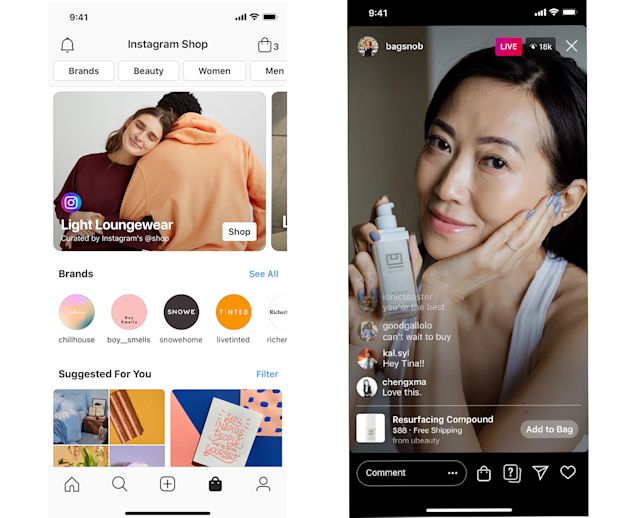
Instagram, which has already been home to many of Facebook’s experiments with shopping, will push Facebook’s new commerce features even more aggressively. The company plans to give shopping its own section of the app, which will replace the current “activity” tab, in an update expected “later this year.”
Instagram
The company also plans to combine live video with shopping — a feature that’s coming to Instagram and Facebook “in the coming months” — which will essentially enable an influencer-lead version of QVC. Brands and influencers will be able to tag specific products before they begin a live stream and viewers will see prominent links to buy the items pinned to the bottom of the video. The move could also give Instagram’s biggest stars another reason to stick around, rather than depart for competitors like YouTube which offer influencers more ways to monetize their content.
Finally, Facebook says it’s testing ways to give businesses the ability to incorporate their loyalty programs into facebook Shops, with features that allow shop owners and users to track and manage points and other rewards as purchases are made.
Update 5/19 1:55pm ET: The post originally stated that Facebook doesn’t yet have its own in-app checkout feature. Facebook does offer checkout to businesses. We regret the error.
While these results are impressive, PlayStation Now has far fewer subscribers than Microsoft’s similar Xbox Game Pass, which has over 10 million users. This disparity could come down to any number of factors, from marketing efforts to the games included in each service’s library.
PlayStation Now could be worth checking out for PS4 owners — $5 a month unlocks access to hundreds of games if you sign up for a year. (The price doubles if you pay month-to-month.) It may also be a good choice for PC gamers, since they can play PS4 exclusives like Bloodborne without having to purchase a PlayStation 4. We’ll have to wait and see if the launch of the PS5 has an effect on PlayStation Now subscriber numbers.
Children the world over count down the days until Christmas, when they’ll be able to unwrap and play with their new toys. Adults, meanwhile, anxiously check the shipping status on their rice cookers and bird watching binoculars when their bosses aren’t looking. Luxury car enthusiasts should have something to look forward to, too, at least according to Porsche. Those who order a 911 can check on the car’s status using the Porsche Track Your Dream service on the company’s website, and stay informed about its production in Germany, all the way up to its arrival at the local dealership.
Porsche Track Your Dreams features 14 milestone events, and expecting customers can read the details about each of them so they know exactly how far along their six-figure purchase is. A countdown clock shows how many days are left before the bundle of joy is delivered to the dealership. (It usually takes between two and three months to have a custom 911 built and shipped.) Porsche Track Your Dreams is only available to 911 buyers at the moment, but the company says that it plans to include the all-electric Taycan in the future. Hopefully this feature helps customers rest assured that their sports car hasn’t been lost in the mail.