The story behind the the digital file started like an intellectual property heist film. A pair of artists claimed to have somehow sneaked into the museum with a 3D scanning rig and captured a surprisingly detailed digital replica of the bust, according to a story in the New York Times.
A number of experts noticed that the quality of the scan was much too high to have been done so hastily and declared it could only have been performed by the museum itself, according to Slate. Once Wenman realized that, he set out to obtain a copy of the file and make it available to the public. Since the Neus Museum is state owned, he initiated an FOIA-like request to get access.
“German freedom of information laws … grant everyone an unconditional right to access official information from federal agencies,” he explained in a Reason article. “That goes for any official record — conventional files, electronic records, drawings, graphics, plans and sound or video recordings.”
Despite the clear-cut law, the state was reluctant to give up the files, worried they would threaten gift shop sales. “The Egyptian Museum sells expensive Nefertiti replicas in its gift shop, and it implied that it needs to protect that revenue to finance its ongoing digitization efforts,” said Wenman. “This argument against open access is known as the ‘gift shop defense.'”
Cosmo Wenman
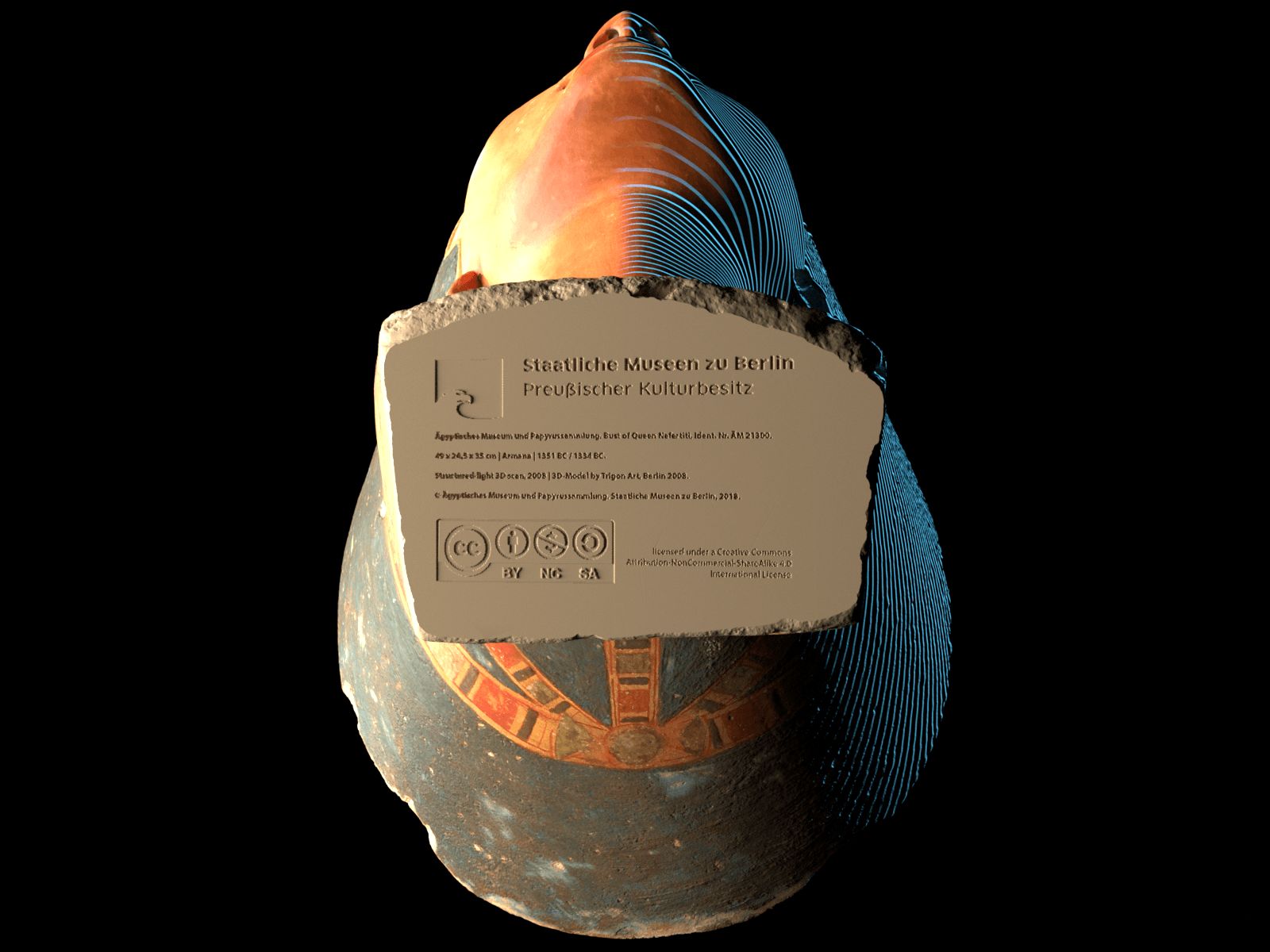
After a lot of back and forth, the museum finally relented and handed over the digital files on a USB key. However, they left it to Wenman to clean up and distribute the scan. The scan also contained a surprise: A copyright notice on the bottom of the bust, along with a non-commercial Creative Commons license.
“It’s unclear which elements of their digital copy of the bust of Nefertiti SPK imagines it has a copyright in,” wrote Wenman. “The original artifact is clearly in the public domain.”
To test it myself, I imported the file into 3DS Max and rendered it using Chaos Group’s V-Ray renderer. The level of detail on the model is incredible, letting you see the unbelievable craftsmanship that went into the 3,364-year-old bust, along with every chip, crack and scrape that happened over time. You can also see the scans and rotate around them on Wenman’s Sketchfab page, and download them from there as well.
The results are incredible, but Wenman wished he didn’t have to go through the three-year effort to bring the scan to the public. “Unfortunately, SPK’s stalling tactics and bad-faith arguments are not unique. (I’ve gone through something similar in my efforts to get the Rodin Museum in Paris to release its unpublished scans.),” he said. “I hope other museums will see SPK’s policy as an example of what not to do with their 3D data.”
The HomePod is one of the best-sounding smart speakers we’ve tested, especially at the sale price. You might have a tough choice between this and Amazon’s Echo Studio. However, the HomePod remains intended for people who are already invested in the Apple ecosystem. You need an iOS or iPadOS device just to set it up, and Apple Music is still the preferred streaming service. And while Siri has a few advantages over rival voice assistants (ask it to turn a Hue bulb white and you’ll actually get white), it’s not as good as rivals at answering general questions or controlling the widest possible range of smart home devices. The HomePod is an audio player first, and everything else second — understand that and you’ll be fine.
The Go has its limitations. It can track your head movements, but it doesn’t have the body-tracking six degrees of freedom you’ll find in the Oculus Quest and many PC VR headsets. At this price, however, it’s an easy pick for simpler VR games, apps and 360-degree video. For that matter, it’s helpful if you just want to catch up on shows without using the TV or disturbing anyone else — it’s effectively a private theater. It’s a solid bargain as long as you set your expectations accordingly.
Here’s a sweet deal on a gift that could make sense for the more adventurous music-makers in your life. Critter & Guitari is running a sale on the Organelle M that drops the price from $595 to $499 from now through December 2nd. At that price, the music computer may be hard to resist — it’s a do-it-all instrument that can stand in as a synth, sampler, sequencer, drum machine or virtually anything else if you have the right code.
You can also expect smaller but sizeable bargains for hotter recent games like Call of Duty: Modern Warfare (down to $50), The Outer Worlds ($45) and Borderlands 3 ($40).
Sony is also offering discounts on key PS4 accessories to go with your system, both inside and outside of the store. Amazon is selling the DualShock 4 for $39, or a substantial $21 off the usual price. A one-year PlayStation Plus subscription, meanwhile, costs just $45 (25 percent off) — we’d consider that virtually mandatory if your recipient is going to play most PS4 games online. Some Sony hardware deals are also available through the PlayStation Store, including the DualShock offer, discounted Gold Wireless Headsets for $70 (normally $100) and a $250 PS VR bundle (typically $350) that includes Blood & Truth and Everybody’s Golf VR.
These are all solid deals, although there is a caveat with some of the hardware. While next year’s PlayStation 5 will have backwards compatibility for games, it’s not clear just how well existing hardware will work with the new console. You may want to splurge on PS4 gear if you either have a specific need for it (say, extra gamepads for local multiplayer) or don’t expect to buy the PS5 for a long while.
Whether you live in your own house or in a shared apartment, temperature control can be tricky — not everyone has the same tolerance for the cold. Thankfully, you’ll find plenty of options to keep you nice and toasty even if your roommate insists on keeping the temperature set at arctic levels. Or if it’s the middle of winter and your building still hasn’t turned your radiators on. (New York City problems.)
Keeping warm indoors
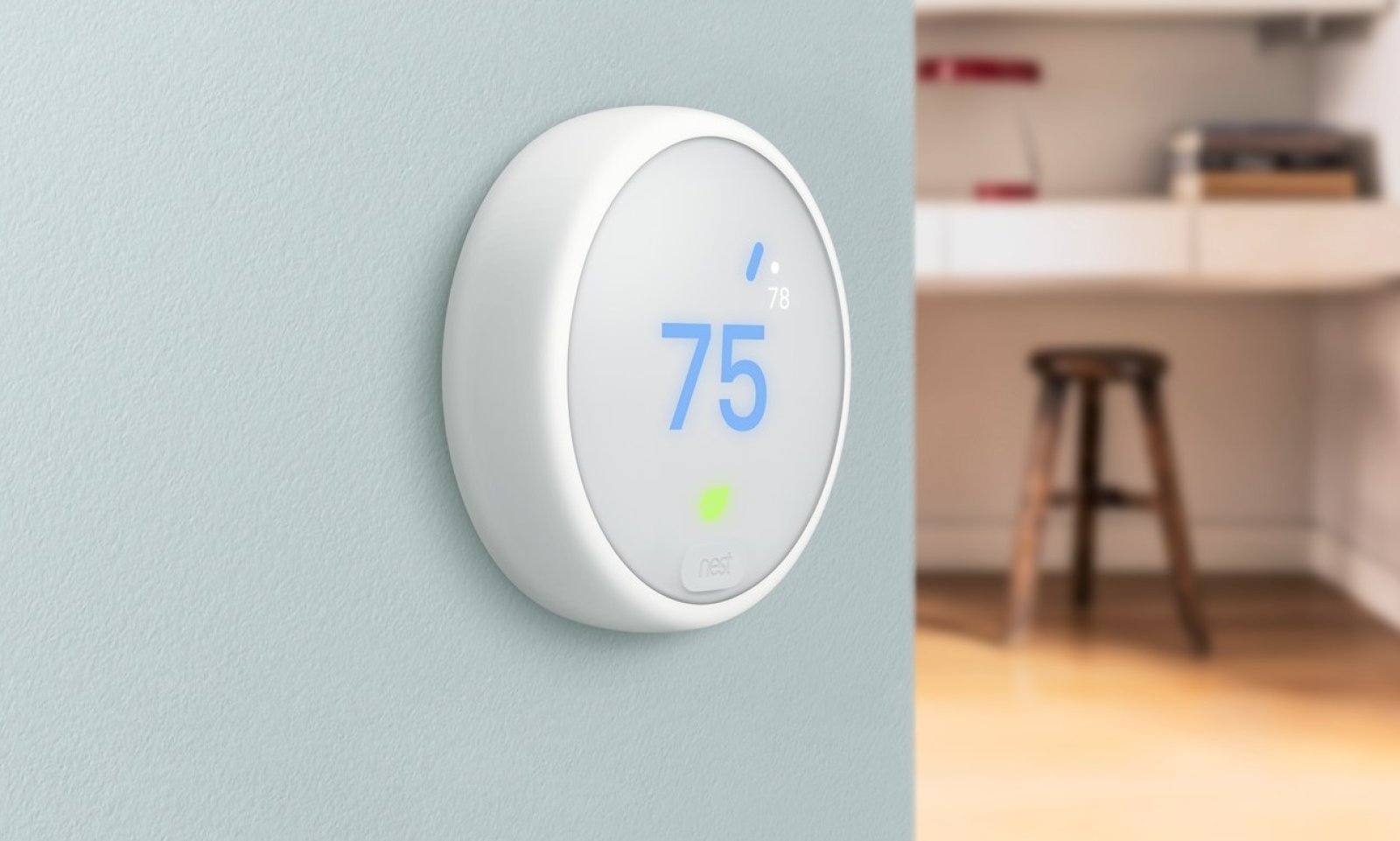
But first, here are some options for those who live alone. Obviously, the best way to keep warm when you’re at home is by adjusting your thermostat or cranking up the heater. Yes, we know you know this, but stay with us: There are ways to make all this a little easier. If you’re able to install a thermostat (i.e., you own your place or don’t have a strict landlord), we recommend the Nest Thermostat E. It’s the industry favorite, and for good reason. The physical controller is easy to use and set up, and the Nest app lets you set your home’s temperature remotely. You can also create schedules to turn off the heat when you don’t need it, which can ultimately save you money. Apple fans might consider the Ecobee 3 Lite, which plays nice with Siri.
If you’re unable (or don’t want) to install a thermostat, you can still have home-temperature control in the form of standalone heaters. Depending on your budget, you could opt for something as high end as the Dyson Pure Cryptomic air-purifying heater. It blows hot air all around your room while also removing allergens, pollutants and formaldehyde, which can cause irritation. If you don’t have $750 to spend on Dyson’s device, consider a WiFi infrared heater like the Heat Storm HS-1500-PHX ($146) that will still give you smartphone control over the device. You can also go even cheaper and pick one of dozens of space heaters available, including this one from Bayka ($40). Just don’t expect to be able to get super precise temperature control or be able to heat up a room before you get there.
Pro tip: If you get a dumb space heater (or dumb anything on this list), you can use a smart plug to easily add remote controls, schedule setting and, in some cases, voice-assistant integration. There are plenty of options available, and they generally cost less than $30. Make sure you look for ones that don’t need a hub — like the Belkin WeMo ($22), SmartThings smart plug ($17) and TP-Link products. Amazon’s own Smart Plug ($25) works with the Alexa phone app, so you don’t need a separate speaker to ask the assistant to turn your heater on.
If cold feet are of particular concern, consider floor heating. You can get an under-rug warmer for extra comfort for your feet like the $220 Woo Warmer. And since hot air rises, this has the added benefit of making your entire space a little warmer.
But if you live with other people who prefer colder environments, they might not appreciate you cranking up the heat in common spaces. You can still keep yourself warm and cozy in these areas by getting a heated blanket. There are plenty of options available, including this $40 microplush throw in a variety of cute patterns. Spend a little more money and you could find a bigger heated blanket like Biddeford’s ($63) that can cover your queen-size bed (or your giant sectional).
I’ve reviewed audio gear professionally since 1990. I have written reviews for magazines and websites including Sound & Vision, Home Theater Review, LifeWire, and Home Theater. I’ve probably conducted more blind tests of audio products than any other journalist, and I’ve tested somewhere around 350 wireless speakers to date. Since 2008 I have brought portable Bluetooth speakers on about 100 trips, from bike tours to transoceanic junkets to week-long trade-show slogs.
For our most recent listening tests, I was a panelist, along with Wirecutter senior staff writer Lauren Dragan and two musicians I often play with in Los Angeles: woodwind player Dan Gonda and drummer Sammy Velick, both in their late 30s. Dan and Sammy have considerable experience in music performance and production. And both of them own a few Bluetooth speakers and have heard many more of them in my home, where I use them to demo jazz tunes for musicians in my jam sessions.
Who should buy a portable Bluetooth speaker
Anyone who owns a smartphone or tablet would probably enjoy owning a portable Bluetooth speaker, which can improve the listening experience anywhere. Bluetooth is available in every current smartphone and tablet, as well as in most laptop computers, so you don’t need additional equipment. Unlike smart speakers and Wi-Fi speakers, Bluetooth speakers don’t require a network connection and the use of special apps—whatever you play on the phone will play through the speaker.
Portable Bluetooth speakers have a rechargeable battery and are frequently waterproof or splash-proof, so you can easily move them around the house or take them to a park or the beach. We’ve found that they make hotel rooms feel more like home.
The best of these speakers deliver sound quality that’s good enough for casual music listening, podcasts, and Internet radio. Although Bluetooth does degrade sound quality slightly, you’re unlikely to hear the effects through relatively low-quality speakers such as these. If you’re worried about it, take the online blind test on my website and see what you think.
If sound quality and volume are your top priorities, and you don’t plan to take the speaker out of your house, you may want to check out the larger, more powerful speakers featured in our other tabletop speaker guides:
For true high-fidelity sound, we recommend a pair of decent bookshelf speakers and a stereo receiver or one of the top picks from our best computer speakers guide. You’ll get clearer sound, much better stereo imaging, and usually much deeper bass response. You can add a Bluetooth adapter if the system doesn’t already have Bluetooth built in.
Voice control of the sort popularized by the Amazon Echo and Google Home is uncommon in portable Bluetooth speakers, because almost all voice-command technologies require a Wi-Fi connection to function. Some Bluetooth speakers provide a button that activates your smartphone’s voice-command technology (such as Google Assistant), but because you can access those features straight from your phone, this isn’t a big advantage.
How we picked
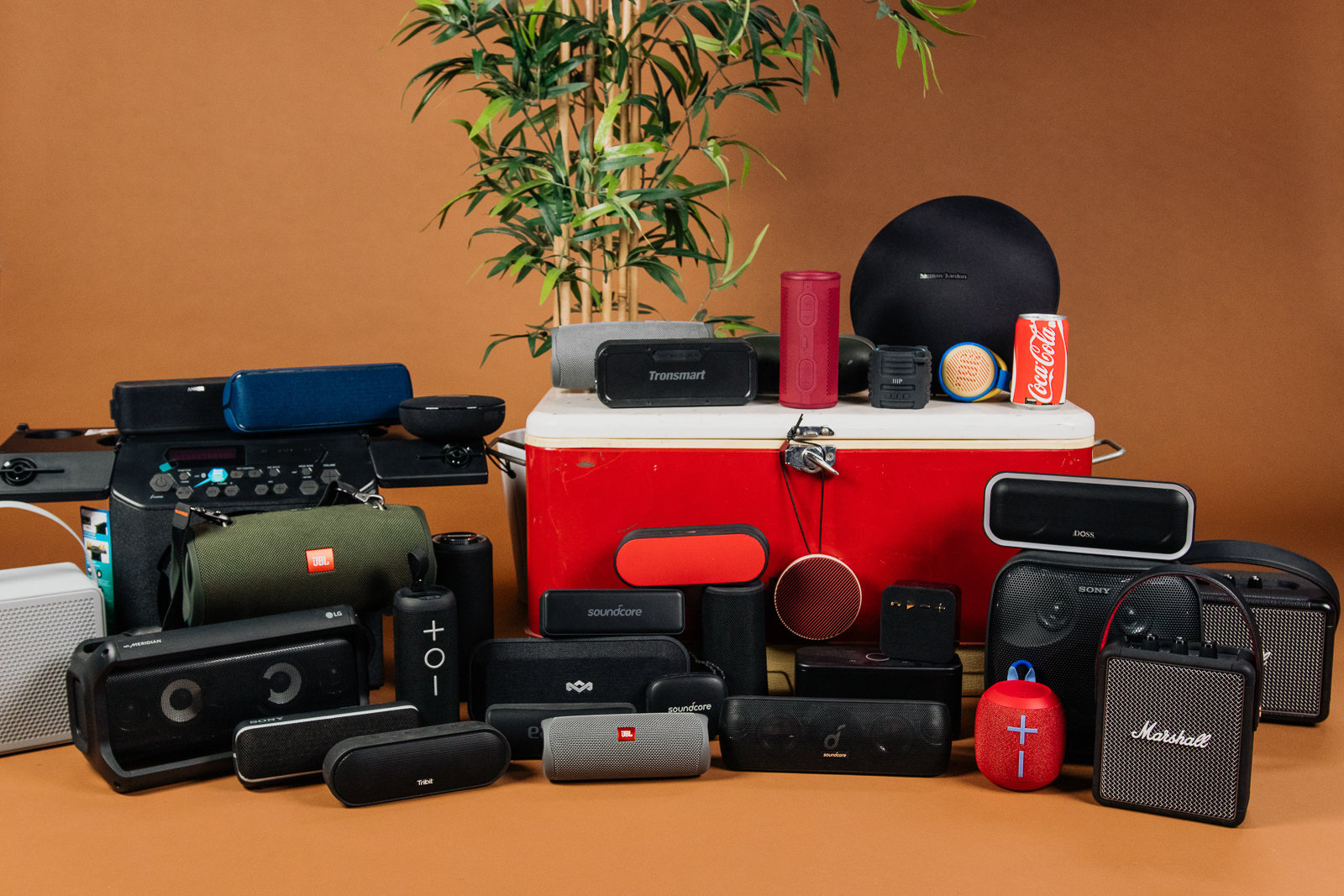
Here are some of the speakers we tested for our fall 2019 update. Photo: Rozette Rago
I’d estimate that there are a couple thousand models of Bluetooth speakers now available, many sold under obscure brands and sometimes only through Amazon. Considering that new ones seem to appear every week, it would be impossible to find and hear them all. But we’ve listened to most of the major models and are always on the lookout for promising new models to test.
We use the following criteria to help us decide which speakers to call in for testing:
Portability and battery life: Although any Bluetooth speaker can be lugged around, we focused on models that have rechargeable batteries and are designed to take a trip to the beach or the park with no hassle.
Ruggedness and waterproof design: We gave priority to speakers that are built to survive the knocks and bumps of travel. Although we didn’t limit our testing to waterproof speakers, we did give preference in our judging to speakers with an Ingress Protection (IP) rating, which tells you exactly how waterproof and dustproof a speaker is.
Price: Even though we would like to test every type of portable Bluetooth speaker, we set a bottom price of $15. Bluetooth speakers are often available for as little as $5, but we’ve never found such an inexpensive model to sound good enough to bother using—especially when the speakers built into today’s better phones can play loud enough for light listening.
Playback controls: Because playback can be controlled from your Bluetooth source device (usually a phone or tablet), we didn’t require the speaker itself to have playback controls, but it’s a convenient plus.
Special features: Bluetooth speakers offer all sorts of features beyond the ability to play audio from Bluetooth-sourced devices. These include speakerphone capability, pairing (the ability to play the same material through two Bluetooth speakers at once), built-in lighting, and even integral bottle openers. In polls and comments, every reader seems to have their own opinion as to which (if any) features are the most important, so we didn’t require any particular features when picking products to test.
After considering all of the criteria, we ended up evaluating 35 new models for the most recent update, including recent releases from 1More, Anker, Audioengine, Doss, EarFun, Heyday, Harman Kardon, JBL, Kew Labs, LG, House of Marley, Marshall, Monoprice, Sony, Tribit, Tronsmart, UE, VicTsing, and Vifa. This brings us to a total of about 270 Bluetooth speakers that we’ve tested since this guide first posted.
How we tested
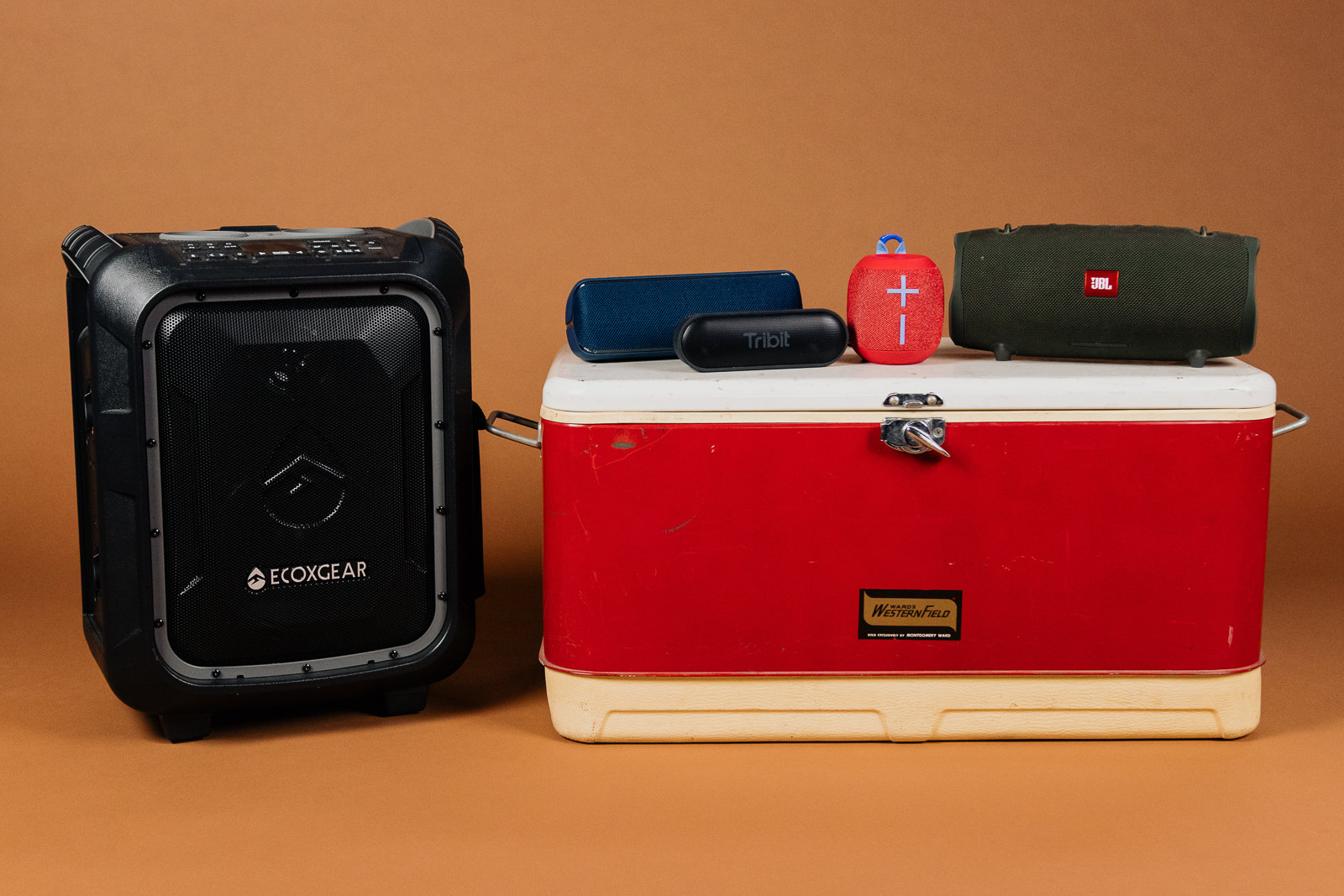
Our top picks, left to right: EcoXGear EcoBoulder+, Sony SRS-XB32, Tribit XSound Go, UE Wonderboom 2, and JBL Xtreme 2. Photo: Rozette Rago
As has become my standard practice for updates to this guide, I started by giving all of the new models a long listen, connecting them via Bluetooth through my Samsung Galaxy S9 phone and playing the same four test tracks: pop, heavy metal, hip-hop, and jazz. I compared the speakers not only with each other but also with some of our previous picks.
I measured the maximum output of each speaker at a distance of 1 meter using an NTi Minilyzer audio analyzer and a calibrated NTi MiniSPL test microphone. For this round of testing, I made one change from our past testing method because I noticed that my previous methods didn’t seem to accurately reflect the perceived maximum volume level in the speakers I tested. I speculate that this is due to the increasing sophistication of the internal limiters that protect the speaker drivers and minimize distortion. So instead of simply playing pink noise and noting the maximum decibel level on the audio analyzer, I used the analyzer’s Leq mode, measuring the average maximum level when playing ZZ Top’s very loudly recorded tune “Chartreuse.” Sometimes the result was a little higher than in previous tests, sometimes a little lower, but I think this approach will deliver a result that better reflects what you’ll hear in day-to-day use.
I narrowed the contestants to the models that I thought had a real chance to impress our listening panel, and I included a couple of past picks.
Although my personal audio tests were, by necessity, sighted (that is, I always knew which product I was hearing), I used a screen of thin black fabric to hide the identities of the products from the panelists. I first set the playback level of each speaker to 74 decibels, using the shaped-noise channel-balancing test tone recorded from a Dolby Digital receiver. Because of the widely varying performance, the coarse volume control steps, and the unpredictable actions of the volume limiters used in these speakers, it was impossible to match levels accurately, but in most cases I was able to get them within plus/minus 0.3 dB.
I played each panelist a mix of tracks known to be good tests of audio quality, such as Tracy Chapman’s “Fast Car,” as well as a couple of tracks of their own choosing. I concluded the test of each speaker by cranking it up as loud as it would go and playing a rock track, such as AC/DC’s “Highway to Hell.” We started with smaller models and moved up to larger ones, and I changed the order of presentation for each panelist.
I asked the panelists to note which speakers they liked best, paying particular attention to:
how clear they sounded at normal levels
the balance of bass to midrange to treble
how loud they were able to play when cranked up
how clear they sounded when cranked up
After the listeners gave me their opinions of the sound, I unveiled the speakers and got their comments about design, features, and price.
I checked the battery life of each of our top picks by repeating Steely Dan’s “Aja” at an average level of 75 decibels (measured at 1 meter), over and over until the power ran out. Note that our results may not agree with the manufacturers’ stated battery life, likely because their testing methodology—which they almost never publish—varies from ours. I also measured maximum Bluetooth range of all our picks.
For models that offer speakerphone functionality, I tried placing a call with each model to Lauren, who has helped me evaluate speakerphone quality for years. I speak to her from the same place in my living room, starting with my mouth 2 feet from the speaker; then I note how she sounds to me, and she tells me how my voice sounds.
Our pick: UE Wonderboom 2
Photo: Rozette Rago
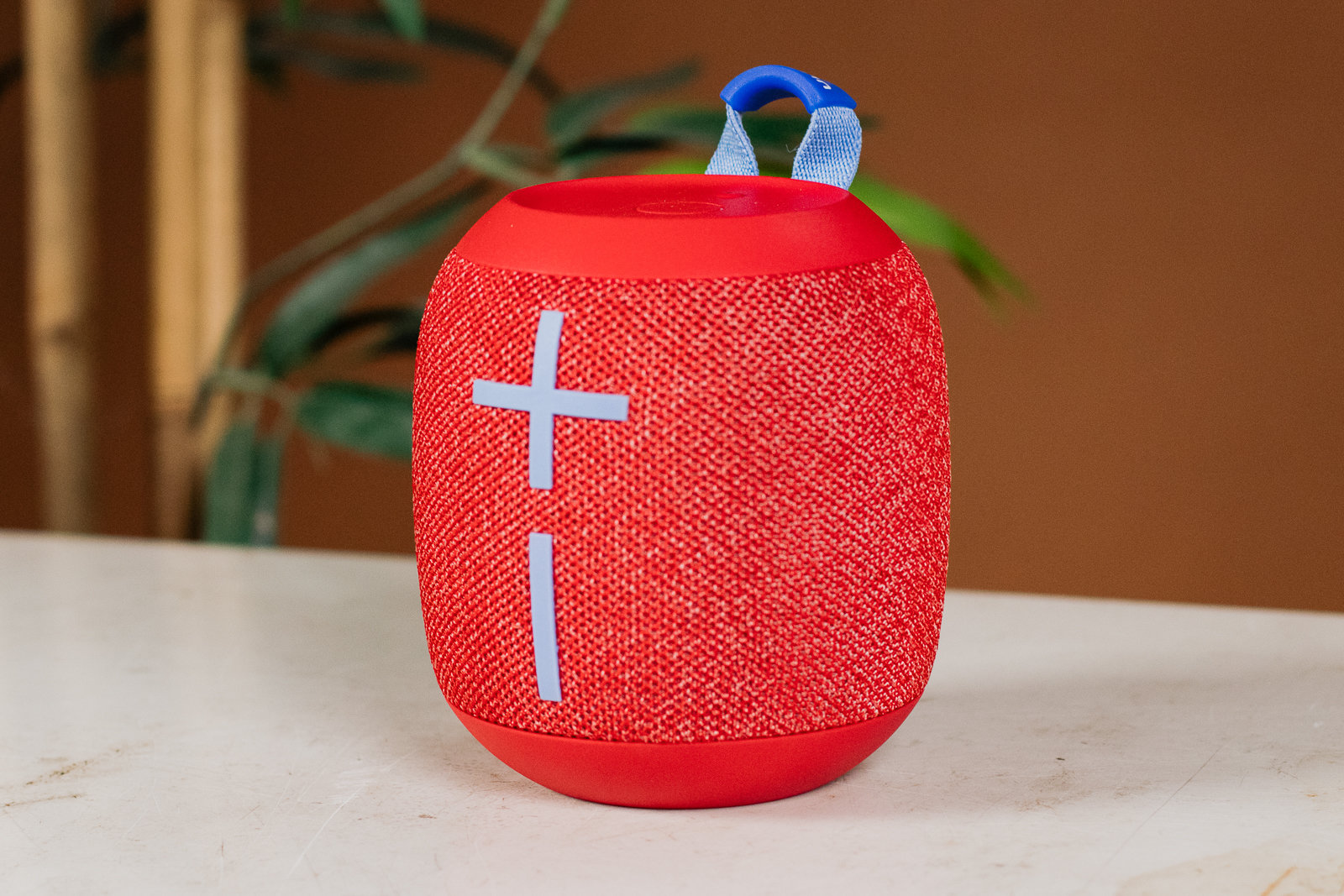
A portable Bluetooth speaker should be compact, rugged, affordable, and (most of all) good-sounding. The UE Wonderboom 2 ticks all of these boxes and then some. Three of our four panelists considered this model’s sound to be the best of any speaker we tested under $100, and they praised its natural balance of bass to midrange to treble, as well as its clear reproduction of voices. The Wonderboom 2 is about the size and weight of a large apple, so it’s easy to carry around. It also has lots of useful features, including an Outdoor Boost mode that makes it louder (at the expense of bass), an ultra-rugged design, stereo/mono pairing, an extra-long Bluetooth range, and a top button that lets you pause and restart the music, as well as skip to the next track.
“The sound is surprisingly clear for such a small speaker,” Sammy said. “It’s the best of the under-$100 models, and definitely the best overall when you consider price.” Lauren added: “It sounds bright, but it’s got enough bass to balance that out—it’s boom and sizzle, where most of the small speakers are all sizzle.”
With an IP67 rating, the Wonderboom 2 is dustproof and waterproof, and it can be submerged in up to 1 meter of water for a half-hour. It also floats, so you won’t lose it if you drop it off a boat or dock or into a swimming pool. UE says the Wonderboom 2 can withstand a 5-foot drop; we confirmed this by dropping it from 5 feet, first onto a hardwood floor and then onto concrete. Not only did it keep working, but it barely even showed a scuff mark. A small, elasticized strap on top lets you hang the Wonderboom 2 from a shower rod, tent pole, or other object, provided you have a carabiner, a hook, or a strand of string to attach it.
In our measurements, the Wonderboom 2 put out 84.6 dB at 1 meter, about the same level you’d hear from the traffic noise if you were standing at a busy city intersection—and enough to fill a small room with sound. The Outdoor Boost mode increased this by about 3 dB—that’s not a dramatic boost, but it is noticeably louder. However, this mode reduces bass, so the speaker doesn’t sound as full and pleasing. Bluetooth range measured an impressive 95 feet through one window.
Flaws but not dealbreakers
If you like lots of bass, this probably isn’t your speaker. I was the only panelist who didn’t rank the Wonderboom 2 as the best speaker under $100 because I was bothered to hear its little speaker drivers choking on some of the deep bass notes in my favorite jazz and pop recordings. If you prefer a bit more bass, the larger (and pricier) Sony SRS-XB32 may be more to your liking.
The Wonderboom 2 lacks a speakerphone function. We wouldn’t use this feature often, but you might.
Battery life is rated at 13 hours, but we measured roughly eight hours, and that’s with four trials of two different units, with the Outdoor Boost mode disengaged. That’s adequate to cover a full workday, but there won’t be any reserve to save you if you forget to keep it charged.
Finally, though the Wonderboom 2 is light and compact, it’s not slim. Its cylindrical design, measuring about 3½ inches in diameter and 4 inches high, takes up more space in a suitcase than some slimmer designs and prevents it from fitting comfortably in a laptop bag.
Upgrade pick: JBL Xtreme 2
Photo: Rozette Rago
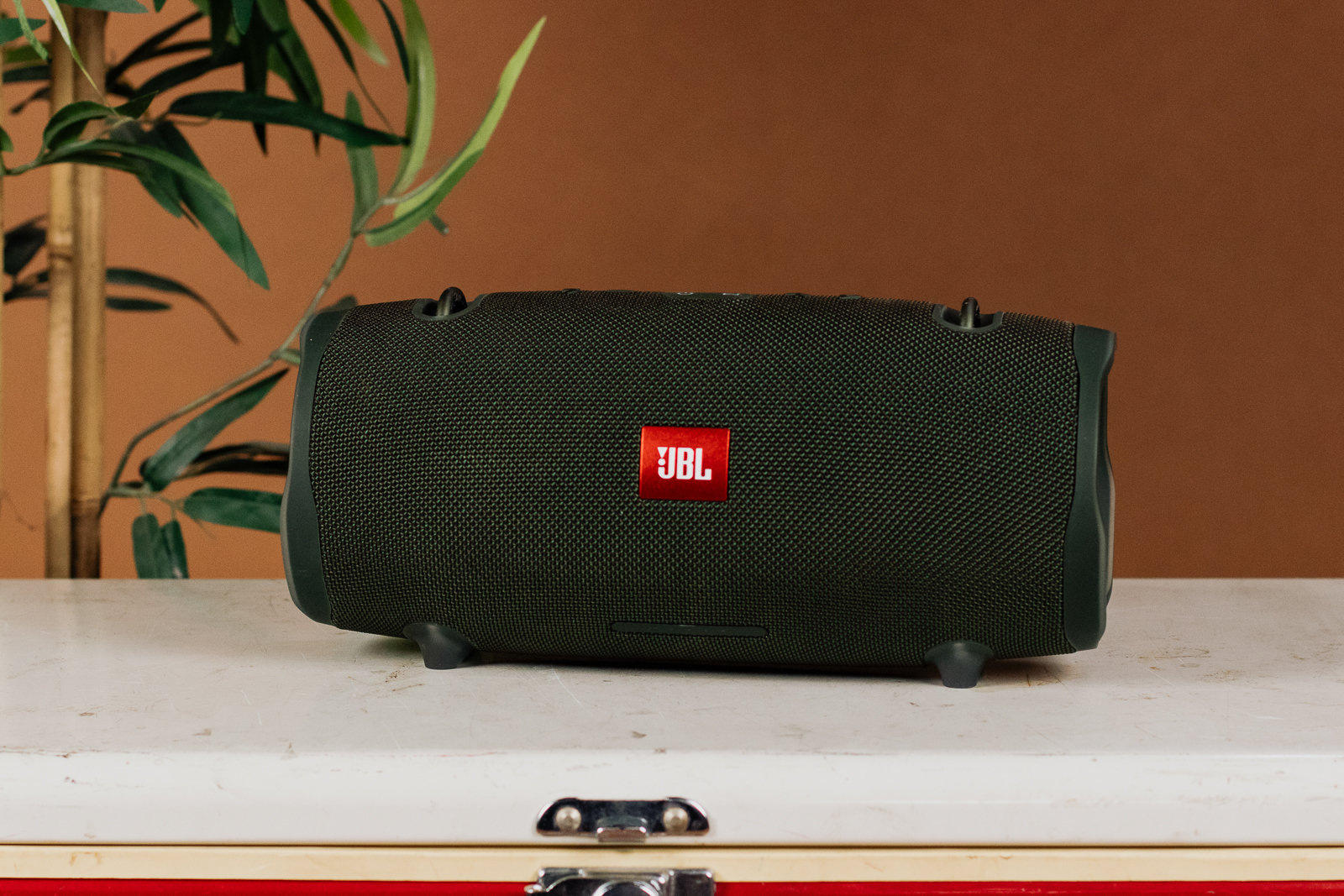
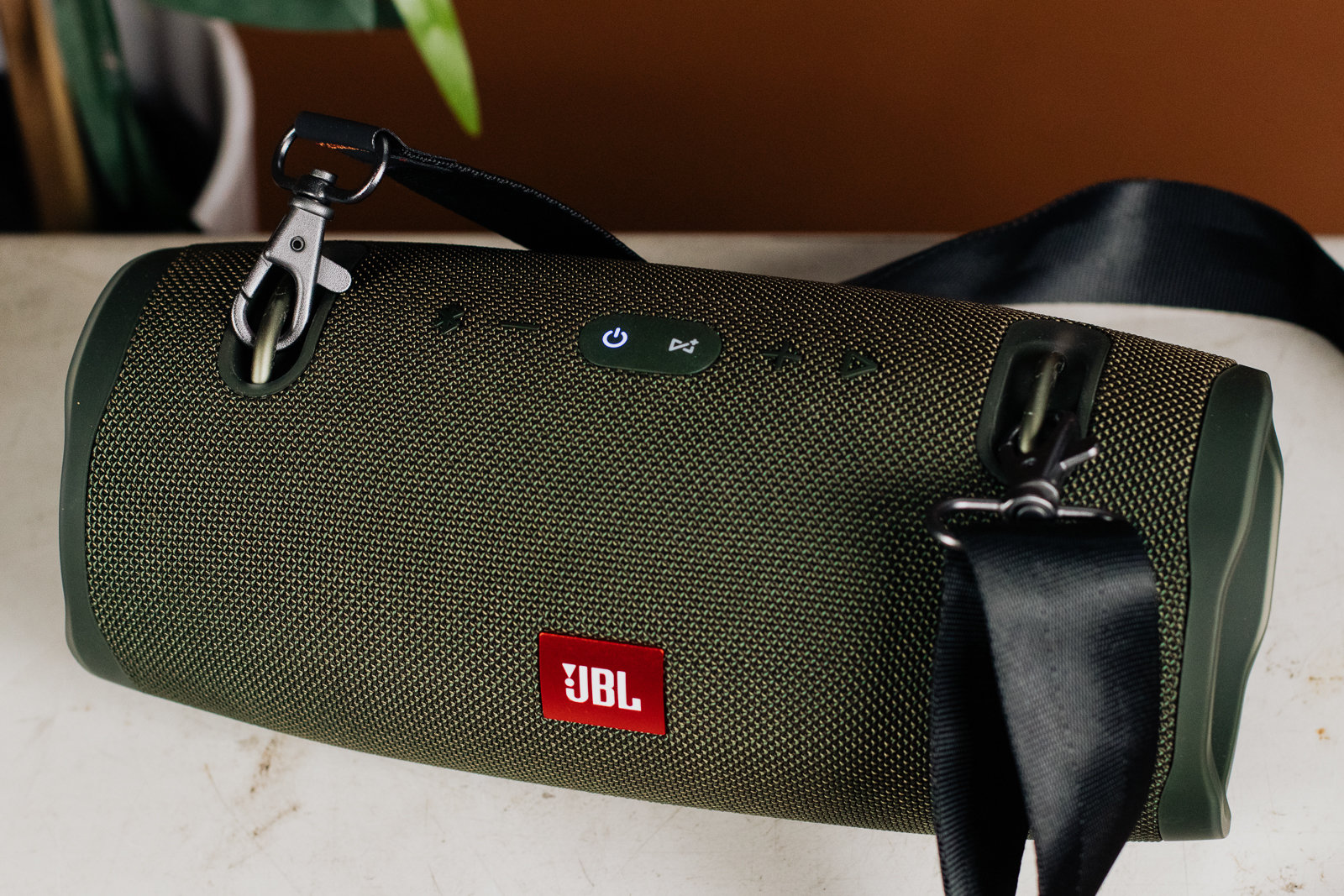
The JBL Xtreme 2 is easily one of the best portable Bluetooth speakers we’ve heard, with a big, full sound that approaches the quality of what you might hear from a good compact stereo system. Three of our four panelists considered it to be the best of all the speakers we tested in this (and probably every) round. The Xtreme 2 is a good bit bigger and heavier than the UE Wonderboom 2 and the Sony SRS-XB32, but its detachable shoulder strap makes it easy to carry to the beach or park. Because the Xtreme 2 carries an IPX7 rating, it can easily survive rogue waves or unexpected downpours.
“It’s the only one that had enough bass to sound good on Kanye West’s ‘Love Lockdown,’ ” Lauren said. “It has a 3D, spacious quality to the sound. Male voices sounded good, although the sound is a little bright, so it makes female voices sound a little harsh.” Sammy and I had similar comments; only Dan demurred, saying the bass was too pumped-up for his taste.
At 11½ inches long by 5 inches in diameter, with a weight of 5.4 pounds (more than four pounds heavier than the Wonderboom 2), the Xtreme 2 isn’t especially compact, and it definitely isn’t light—but thanks to its thick canvas shoulder strap, it’s easy to lug around. The strap even has a bottle opener built into its buckle.
Although the Xtreme 2 put out a relatively modest 89.9 dB at 1 meter in our tests, it seems far louder because the sound is so full and the bass really kicks. Battery life is rated at 15 hours, and we measured 19 hours in our tests. Bluetooth range measured an impressive 110 feet through one window.
The Xtreme 2 is larger and heavier than our UE and Sony picks, but the included shoulder strap makes it easier to carry around. Photo: Rozette Rago
There’s a speakerphone function—when I called Lauren, she described my voice as sounding “clear, but a little compressed,” but her voice sounded great on my end of the call. The Connect+ function lets you connect up to 100 Connect+ speakers together for mass playback (although that’s 98 speakers more than most people would probably want to connect). The play button on top lets you pause and restart playback and skip to the next track.
The Xtreme 2 has two real downsides. The first is that it’s expensive—about twice the current price of our previous upgrade pick, the Sony SRS-XB41. But three of our four panelists greatly preferred the sound of the Xtreme 2, so for listeners who want a very loud, clear, and full-sounding speaker, we expect it’ll be worth the extra cost.
The second downside to the Xtreme 2 is that it charges only through a separate AC adapter, which of course you’ll have to remember to bring with you if you want to play it for more than 19 hours. A speaker this big and powerful would charge much too slowly through a Micro-USB cable, but we wonder if switching to USB-C (as so many other Bluetooth speakers have done) might have been preferable.
Also great: Sony SRS-XB32
Photo: Rozette Rago
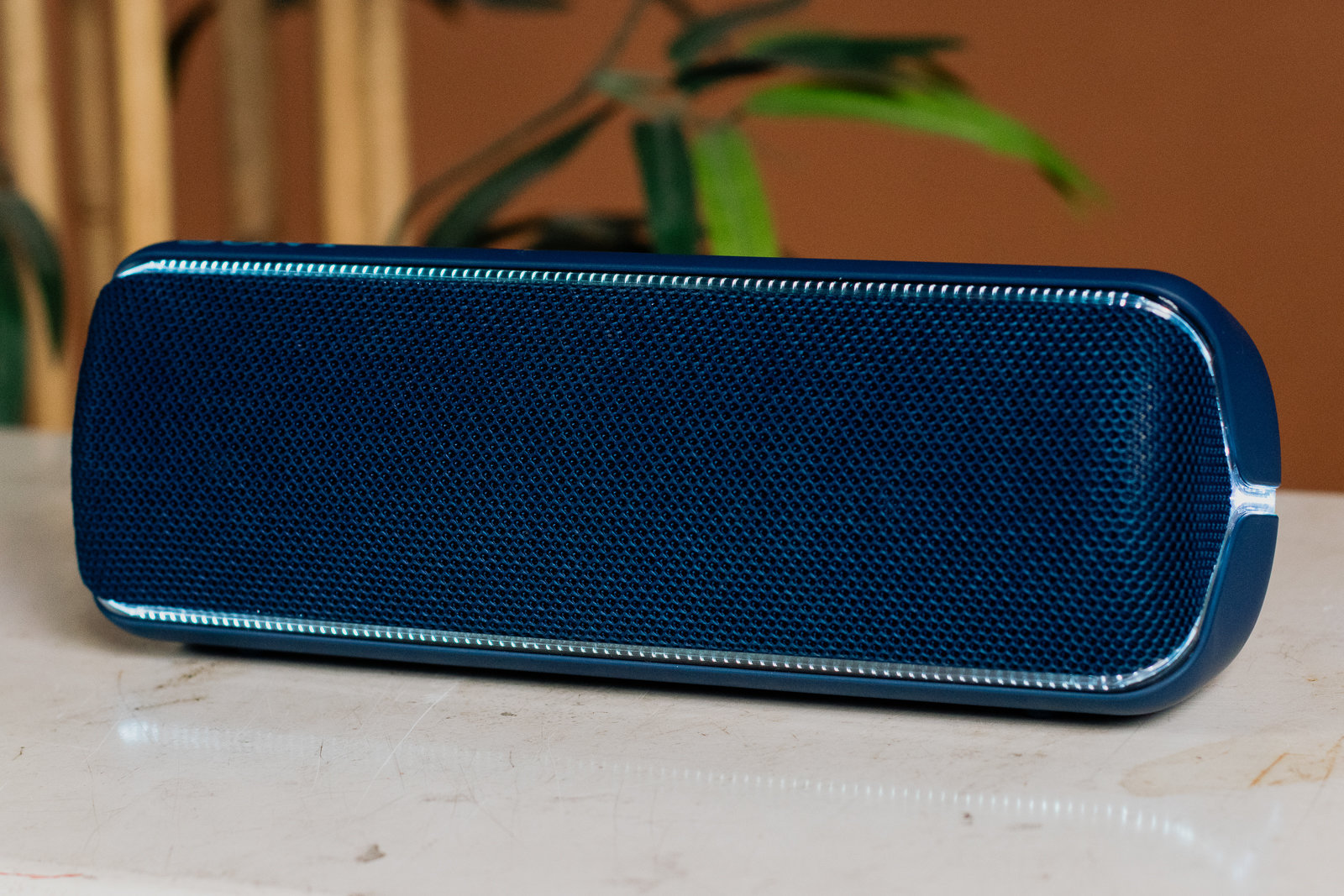
The Sony SRS-XB32 is the speaker to get when you need a bit more speaker than the UE Wonderboom 2 but not as much speaker as the JBL Xtreme 2. It’s about twice the size and weight of the Wonderboom 2 (and a notable step up in price), but it has a fuller, bassier sound that would make it a reasonable substitute for a small stereo system—and a better choice for use in a dorm room or bedroom. The SRS-XB32 also has a variety of features that we expect some listeners will think are awesome and others will think are silly.
“Overall, this one sounds very good,” Dan said. “The sound is well balanced between bass and treble, and it never sounds nasty, as some of these speakers did.” Lauren, Sammy, and I generally shared Dan’s sentiment: The SRS-XB32 won’t make you forget you’re listening to a compact Bluetooth speaker, but it’s satisfying for casual listening at home, small backyard gatherings, and sharing tunes with a few friends at the beach. The Extra Bass button lets you punch up the lows when you put on hip-hop, heavy metal, or taiko drum recitals.
The SRS-XB32 measures 9.3 by 3.1 by 3.2 inches and weighs 2 pounds—that’s a little too big to toss into a suitcase without a second thought, but small enough to toss into a car trunk or beach bag. Because it’s IP67-rated, it’s dustproof and waterproof, so there’s no need to worry if it encounters sand, splashes, or rain.
Like some of Sony’s other portable Bluetooth speakers, the SRS-XB32 has multicolored lighting that can be adjusted through a smartphone app. We’re not particularly fond of this feature, but if you like this sort of thing, then you’ll like this sort of thing. The SRS-XB32 also includes Sony’s Party Booster feature, which produces various percussion sounds when you slap the speaker on the front, sides, top, or bottom. I can’t imagine what kind of party might be enlivened by this feature, although I can attest that the sounds will stop a misbehaving shih tzu from doing whatever she’s doing.
Battery life is rated at 24 hours with Extra Bass off and 14 hours with Extra Bass on, but for us the battery life didn’t come close to Sony’s ratings. Even with Extra Bass off, the SRS-XB32 ran for only six hours before it automatically reduced its level to preserve battery life; it lasted another five hours after that. We saw this same behavior in the SRS-XB32’s predecessor, the SRS-XB31, but unlike the SRS-XB31, the SRS-XB32 is still usable when it reduces its volume. So the SRS-XB32 will probably last through a day at the beach, but don’t forget to charge it when you’re done listening.
At full blast, the SRS-XB32 puts out 87.4 dB at 1 meter. That’s almost 3 dB more than the Wonderboom 2, but the Sony’s fuller sound makes it seem even louder. Bluetooth range measured about 50 feet through one window. You can connect up to 100 compatible Sony wireless speakers for synchronized playback. You can even sync the lights. The play and pause button on top lets you pause and restart playback and skip to the next track. When we tested the speakerphone function, Lauren reported that my voice sounded fairly clear and natural, but her voice sounded like she was speaking into a disposable plastic cup.
Budget pick: Tribit XSound Go
Photo: Rozette Rago
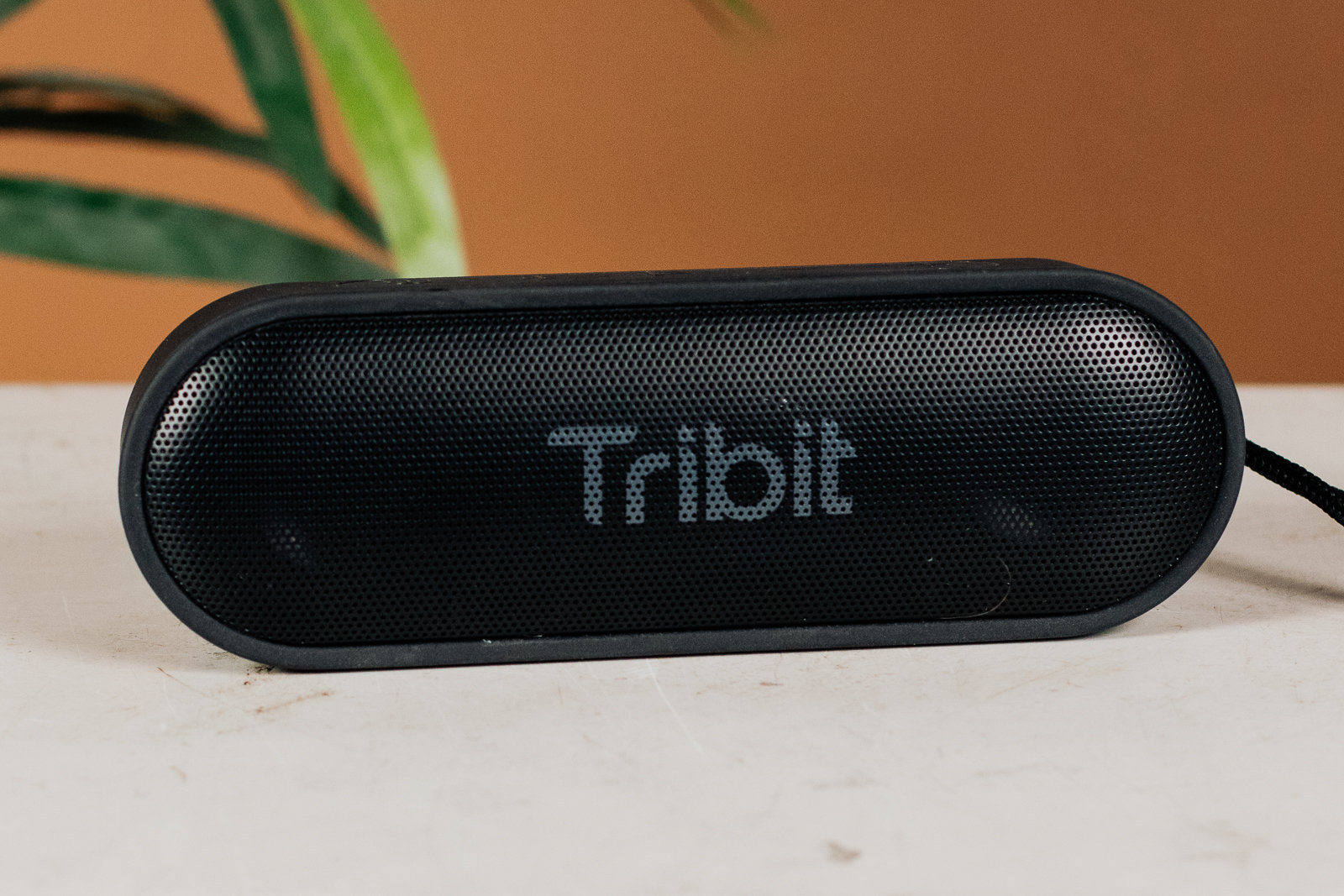
If you want a great all-around portable Bluetooth speaker for about the cost of a tank of gas, the Tribit XSound Go is a terrific choice. Sonically, it’s a step up from anything else we’ve heard in this price range, with clearer sound and more bass than most competitors can muster. This speaker is easy to travel with, too—it’s small enough to slip into a laptop bag or any suitcase. Plus, it’s IPX7-rated, which means it’s sufficiently waterproof to survive a half-hour swim in 1 meter of water.
When the XSound Go accompanied me through four weeks of travel, I continued to be surprised by how clear and full its sound was. Voices sound natural and distinct, never bloated or hoarse, as they can through most inexpensive Bluetooth speakers. The XSound Go doesn’t sound as full or play as loud as the Wonderboom 2, but all of the panelists thought it delivered amazing sound quality for its price. Measured maximum volume was 82.4 dB—not enough to get a party going, but enough for light listening in a typical living room.
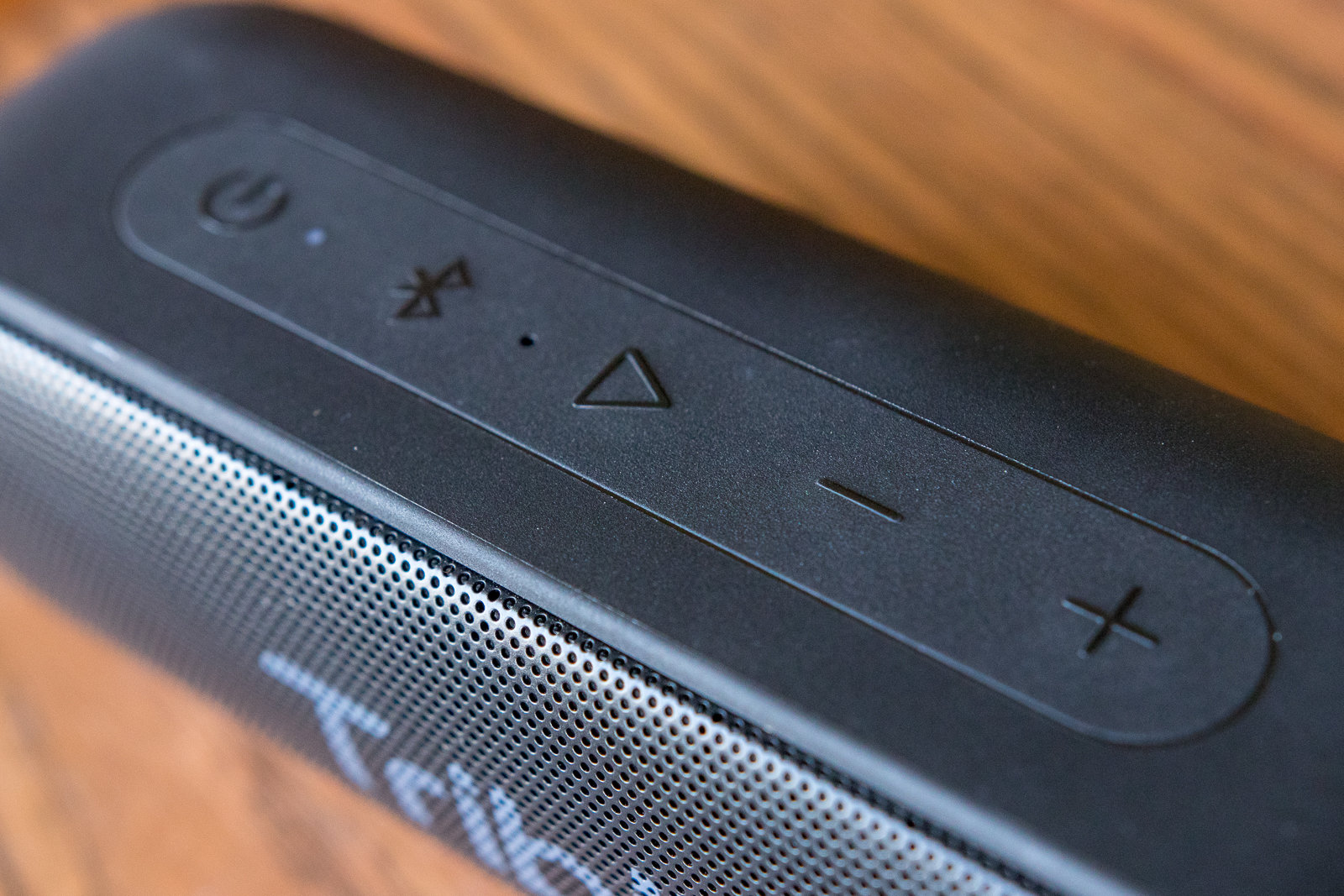
The XSound Go has play/pause and volume buttons, but it lacks track-skip controls. Photo: Kyle Fitzgerald
There’s nothing flashy about the XSound Go, but it doesn’t have that cheap, plasticky look that many budget Bluetooth speakers have. Although it has a play/pause button on the top, it doesn’t have track-skip buttons, which would come in handy if you used the XSound Go in the shower. The battery is rated for 24 hours of life; we got only about 10½ hours, but for a cheap Bluetooth speaker, that’s fine.
The XSound Go’s speakerphone function is good, especially for the price. I could hear Lauren very clearly, although she complained that my voice sounded slightly muffled. In our tests, Bluetooth range was about 25 feet through one wall, which is good for a speaker of this size.
Also great: EcoXGear EcoBoulder+
Photo: Rozette Rago
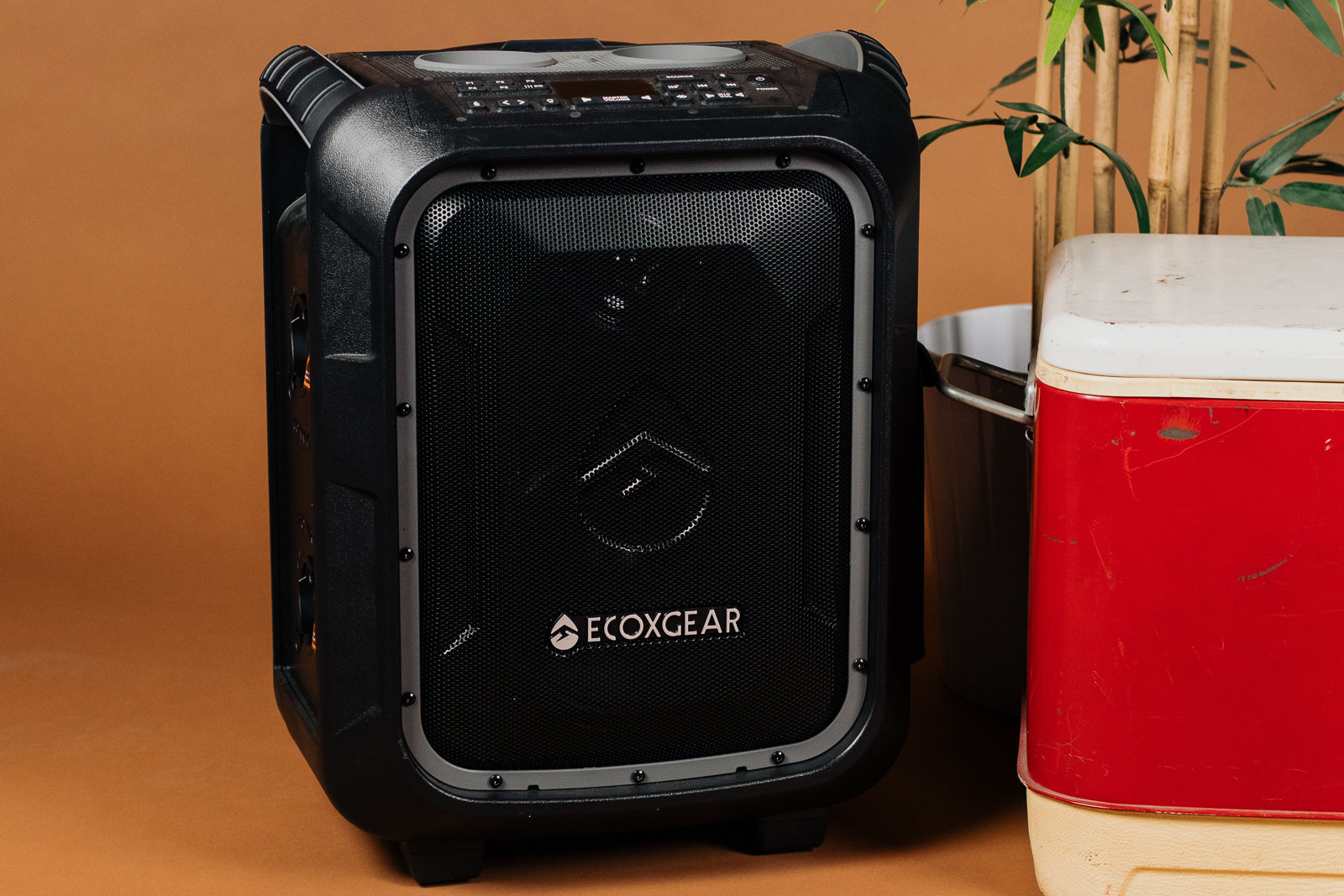
About two years ago, the “pool blaster” Bluetooth speaker category emerged: large models that have high volume levels and a waterproof design. Many people would love having a speaker like this for pool parties or tailgating, but the EcoXGear EcoBoulder+ is the first we’ve found that delivers the combination of volume and sound quality we’d been hoping for—at a price that’s typically $100 to $150 less than that of many competing models.
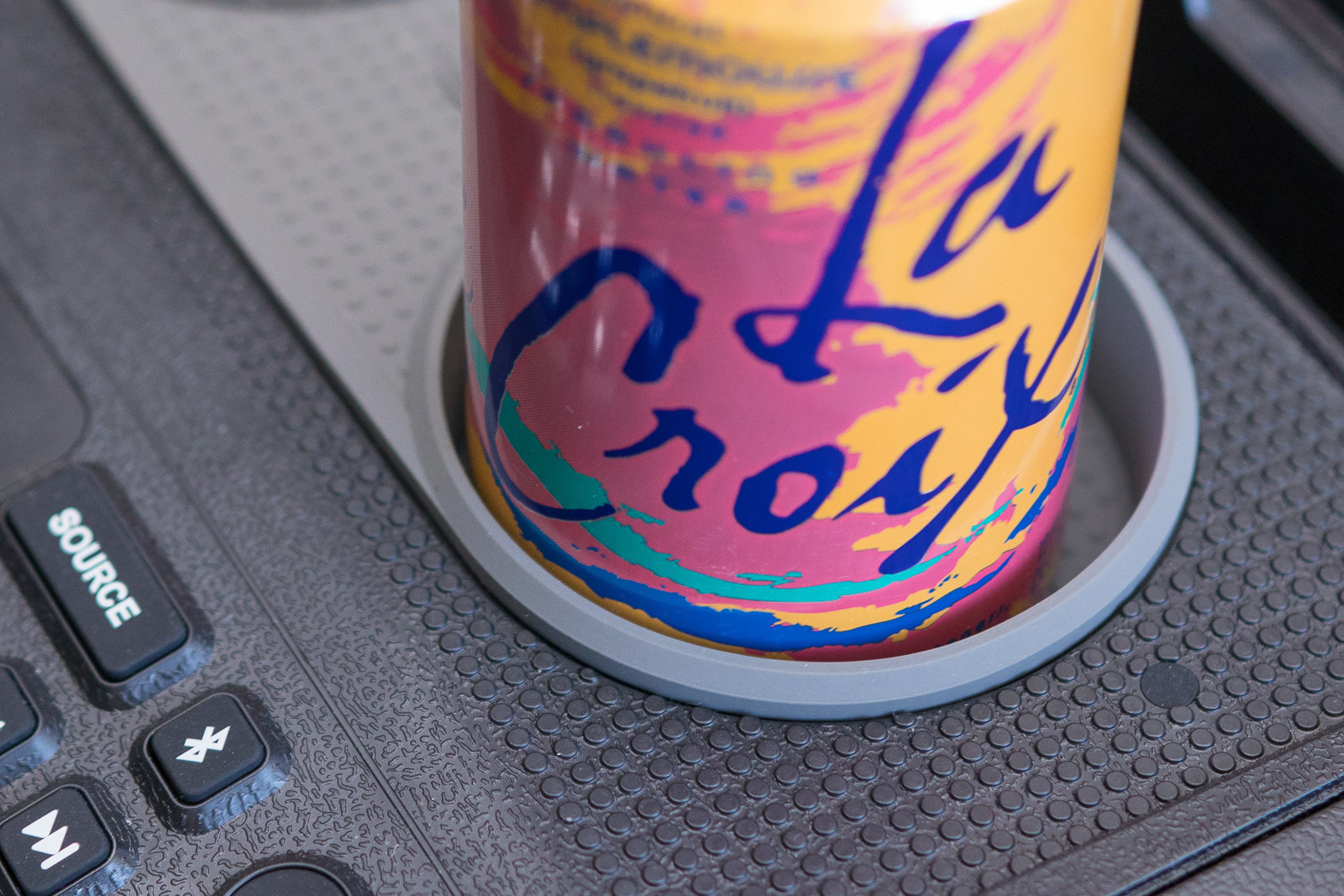
The EcoBoulder+ has many convenient features, including cupholders. Photo: Kyle Fitzgerald
This is easily the best-sounding pool blaster we’ve heard to date, with an even balance of bass, midrange, and treble that presents all instruments and vocalists naturally without calling attention to (or mangling) any one element of the music. The EcoBoulder+ is built much like a good home stereo speaker, with an 8-inch woofer below a 3-inch tweeter, and an 8-inch passive radiator in the back to reinforce the bass. The big speaker drivers and the built-in amp rated at 100 watts allowed the EcoBoulder+ to hit 104.1 dB in our tests, about 14 dB louder than the JBL Xtreme 2. That’s loud enough to cover a typical suburban backyard. If the sound isn’t quite to your liking, bass and treble controls let you fine-tune it, but we never felt the need.
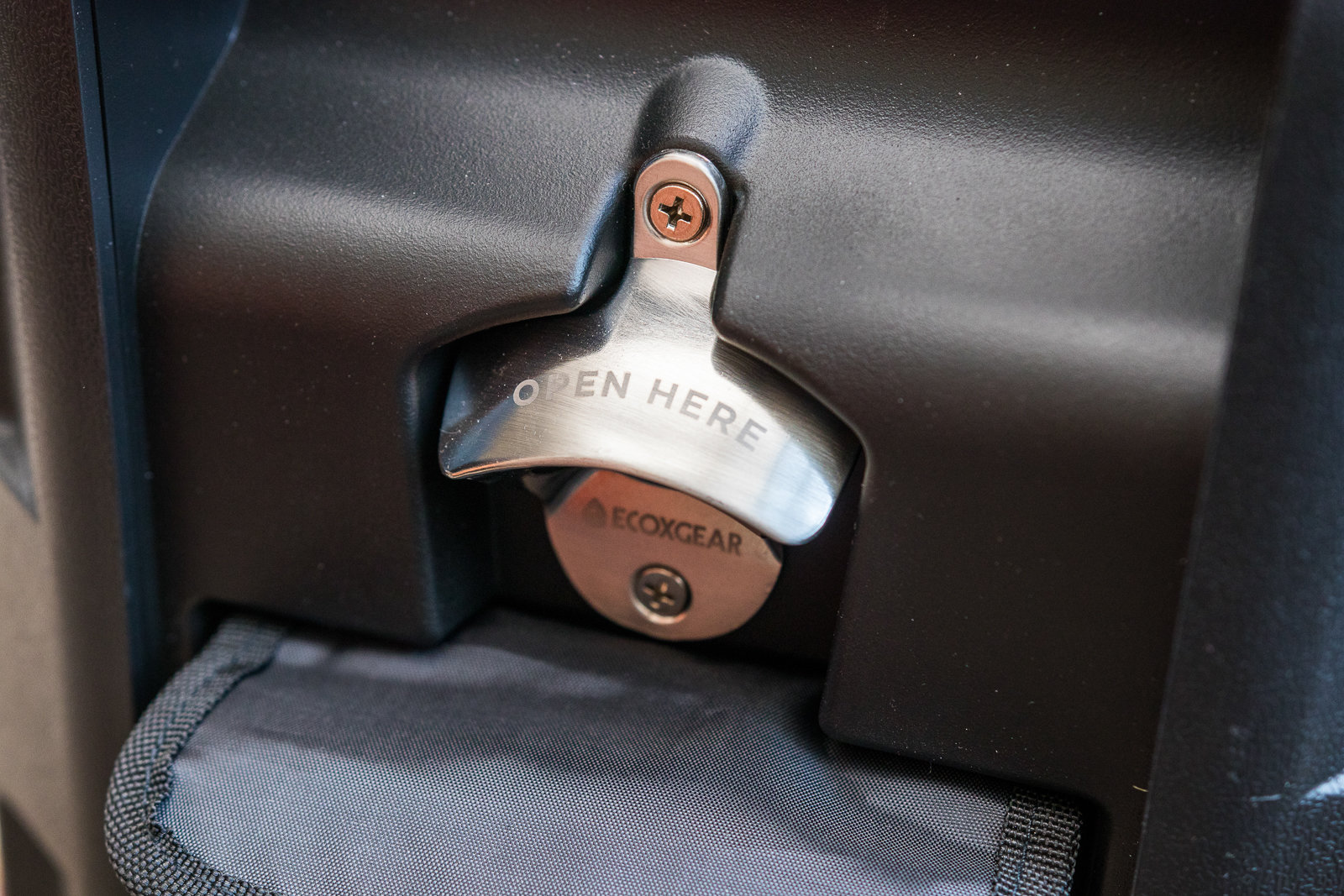
The EcoBoulder+ has many convenient features, including a bottle opener. Photo: Kyle Fitzgerald
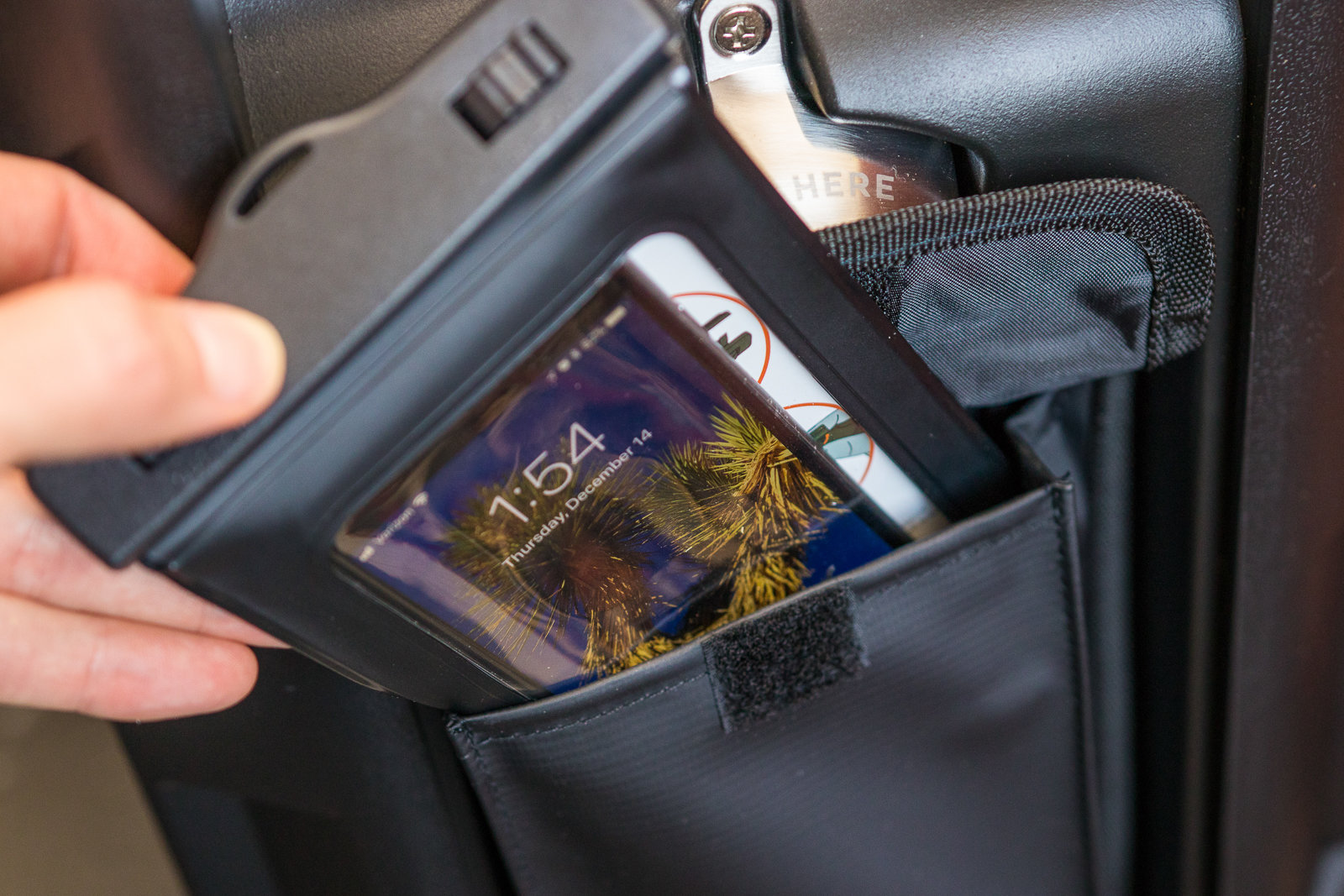
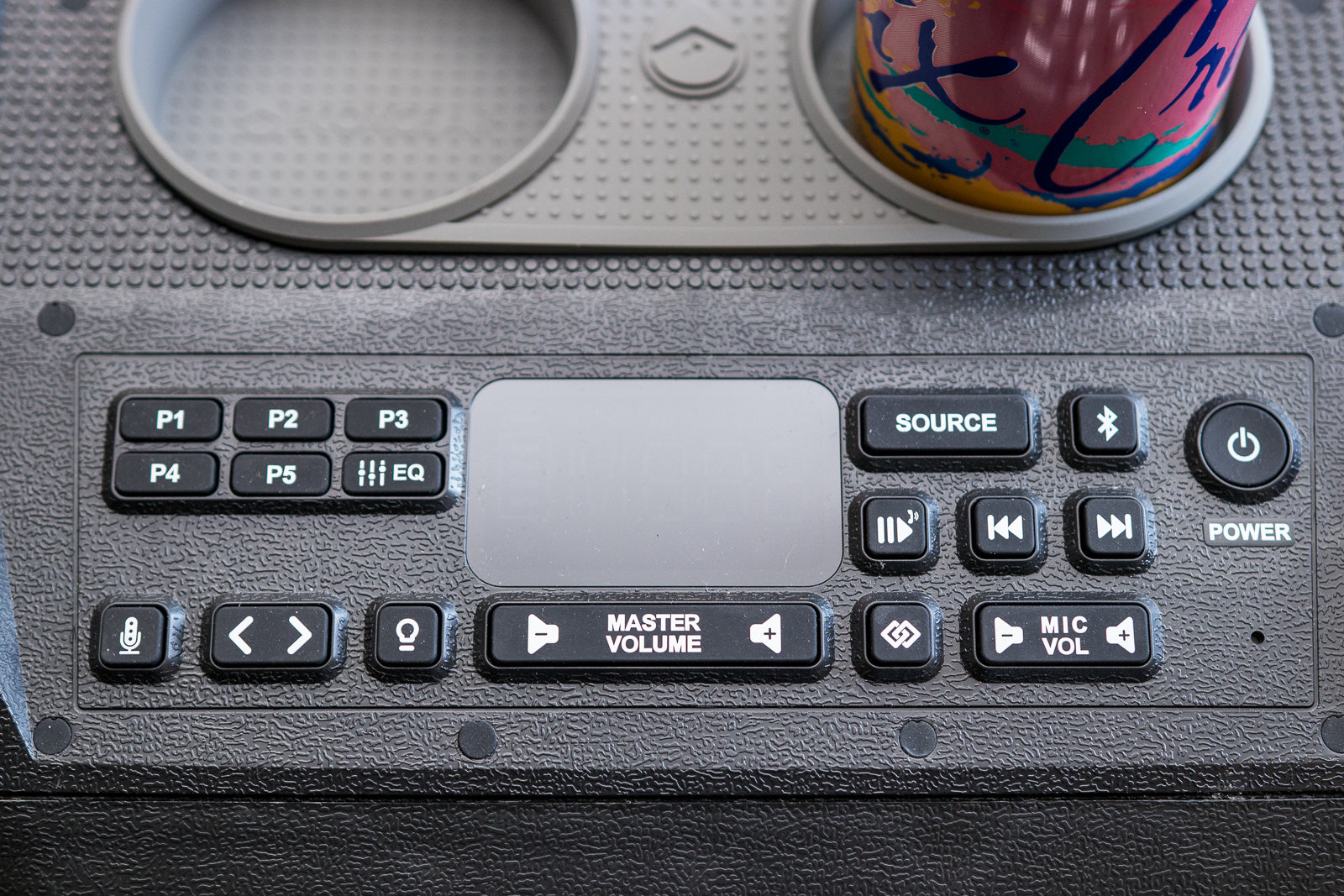
The EcoBoulder+ is also easy to cart around. With a retractable handle and built-in wheels, it scoots around just like a roll-aboard suitcase. Sturdy handles on top allow two-handed lifting. It’s IP67-rated, which means it’s waterproof and dustproof, and it also has a waterproof pocket on the side for a smartphone. A bottle opener on the side and two cupholders on top facilitate consumption of beer or a bottle of Mexican Coca-Cola. This model also has a built-in AM/FM radio, so tailgaters can listen to the game. A ¼-inch jack on the speaker’s side lets you connect a microphone (not included), so you can use the EcoBoulder+ as a little PA system. In the unlikely event that you need more volume, you can pair two EcoBoulder+ speakers for stereo sound.
Surprisingly, the EcoBoulder+ even has a speakerphone function, so if you ever need to do a conference call with 30 people while sitting poolside at a Florida resort, you’re good to go. Even more surprisingly, the speakerphone function is one of the best we’ve tested, with excellent voice quality at both ends.
The EcoBoulder+ has many convenient features, including a waterproof pouch for your phone. Photo: Kyle Fitzgerald
A power socket lets you connect a standard AC cord for charging. Battery life is rated at 10 hours at full volume. Considering that few people will buy the EcoBoulder+ to play music at normal indoor levels, we ran our battery-life test with the volume set 6 dB louder than we did with the other models we tested (which in a normal living room sounds pretty loud). Even at this higher volume, the EcoBoulder+ ran for 24 hours on a charge. Bluetooth range in our tests was about 43 feet through one wall, enough that you could probably leave your phone indoors while the EcoBoulder+ played out by the pool.
One panelist summed up the EcoBoulder+ nicely when he said, “They obviously took a hard look at what a person wanting a speaker like this would need, and they put it all in there. And it sounds way better than anything similar we’ve tested.”
The EcoBoulder+ speaker’s top-mounted buttons let you skip tracks, mix in the signal from a microphone, and set and access tone presets. Photo: Kyle Fitzgerald
What to look forward to
Other than the Wharfedale Exson M (a surprisingly inexpensive model from a brand revered by audiophiles) and the Aiwa Exos-X8 (a 24-inch-high, 25-pound potential competitor to the EcoXGear EcoBoulder+), we aren’t aware of any major new portable Bluetooth speaker introductions pending. The only ones introduced at the recent IFA show in Berlin also had Wi-Fi capabilities, putting them outside the scope of this article.
We’ll likely do our next update in spring 2020, when the new models that we expect to see introduced at CES in January will start to become available.
The competition
We’ve tested more than 270 portable Bluetooth speakers specifically for this article. Some competitors came very close to our top picks in performance and value, and they may be worth considering, depending on your priorities. Here’s a list of some of the more recent models we’ve considered, in alphabetical order.
The circular 1More Portable BT Speaker produced distorted bass, made voices sound unnatural, and seemed to vibrate a bit on the table we placed it on.
In our tests, the Altec Lansing Sonic Boom 2 didn’t play anywhere near as loud as we think a “pool blaster” speaker should.
Although we found that the Altec Lansing Super Life Jacket played loud and had impressive bass for its size, we thought the sound was rather rough and uneven.
The Anker SoundCore has a low price and an appealingly simple design, but it didn’t sound as full and smooth as the Tribit XSound Go.
The Anker SoundCore Boost loses voice clarity with its bass boost mode activated, but without it, we thought the bass was usually lacking.
We thought the tiny Anker SoundCore Icon Mini didn’t play loud or clear or full enough to warrant the investment.
The Anker SoundCore Motion+ plays very loud for its size and cost, but voices have a boosted, unnatural quality, and the bass doesn’t cut it for hip-hop and pop.
Our panelists preferred the Tribit XSound Go to the Anker SoundCore Motion B, but all thought the Motion B sounded pretty good—and it is an excellent value.
The Anker SoundCore Sport XL plays very loud for its price, but our panelists found its sound to be a little too harsh.
Our panelists thought the Aomais Go had a nice, full sound and a reasonable price, but they thought it was rather bulky for the volume it delivered.
We liked the clarity of the Audioengine 512 on vocals and most instruments, but thought its bass and lower midrange weren’t strong enough to handle most hip-hop and heavy rock.
The Aukey SK-M12 SoundTank might be the loudest Bluetooth speaker we’ve heard in the $50 price range, but we thought its sound was too bright and edgy.
Our panelists loved the sound of the B&O Beoplay A1, but they lost their enthusiasm when they saw its high price.
We like the Bose SoundLink Color II a lot, but we think the Sony SRS-XB32 is more useful and sounds more powerful.
The Bose SoundLink Micro sounds surprisingly full for its size, but for its price it doesn’t play all that loud.
The Bose SoundLink Revolve has a big, full sound, but in our tests we thought it distorted too much for something in its price range.
The Bose SoundLink Revolve+ has an even fuller sound than the Revolve, but our panelists complained about unnatural fluctuations in volume due to its internal limiter settings.
The Braven 105 doesn’t play very loud, but it sounds fairly clear and full for its size, and its integral elastic strap makes it a good speaker to hang from shower-curtain rods.
The Braven Balance has a nice, slim design and a reasonable price, but our panelists thought it didn’t play loud enough for its size.
With a built-in MP3 player and MicroSD card slot, plus a USB input, the Creative Sound Blaster Free is a nice speaker for its price, but we think our top picks sound better.
The Creative iRoar Go didn’t please our panelists; two complained about a buzzy sound in the midrange and some distortion in the bass.
The Doss SoundBox Touch is our former pick for best budget Bluetooth speaker, but the Tribit XSound Go delivers comparable sound in a smaller chassis.
The Doss Traveler is a campsite-friendly speaker with integral LED flashlights. It plays clear and loud, but our panelists liked the Tribit XSound Go better.
The Doss SoundBox Pro doesn’t really sound better than the Tribit XSound Go, and it’s larger and costlier.
We found the sound of the Doss SoundBox Plus thin and unpleasant, especially on voices.
The EarFun Go is similar in size, design, quality, and price to the Tribit XSound Go. Our panelists had a slight preference for the XSound Go, but either is a good buy.
Two of our panelists praised the EarFun UBOOM for its clear and balanced sound, but two panelists thought its clarity was lacking.
The Edifier MP200 is a cute, cube-shaped speaker that sounds good but doesn’t play as loud as some competitors, and it scoots around a bit when playing music with a lot of bass.
The Edifier MP700 sounded impressively clear, but it didn’t play as loud as we’d hoped for its size, and its metal handle made it heavy to lug around.
Our panelists thought the Fender Newport sounded great, but it’s not convenient for portable use. If you like the Newport’s guitar-amp styling, we strongly recommend it.
The Harman Kardon Onyx Mini has a generally pleasant, fairly full sound, but our panelists thought its sound on bass-heavy music was distorted and indistinct.
We liked the full, clear sound of the Harman Kardon Onyx Studio 4. And even though its rechargeable battery and integral handle make it technically portable, it’s large enough that you probably wouldn’t want to carry it much farther than the backyard.
The iHome iBT374 is nicely priced for the volume and bass it delivers, but our panelists thought the unit’s strong bass and treble overshadowed vocals.
The Jam Hang Around and Jam Hang Tight are beautifully designed, affordable waterproof speakers with cool integral charging cords, but their sound distorted too often for our taste.
Our panelists thought the JBL Charge 4‘s bass sounded too dull and boomy.
The JBL Clip 3 is a nice, ruggedly designed small speaker, but our panelists didn’t like its near-total lack of bass. And this model’s small integral clip makes it hard to hang off of most objects.
JBL’s Flip Bluetooth speakers are practical, powerful, and reasonably priced. But as with past Flips, our panelists thought the JBL Flip 4 sounded too thin and needed more bass.
The JBL Flip 5 came very close to being a top pick—it falls between the UE Wonderboom 2 and the Sony SRS-XB32 in price and performance. Our panelists thought it sounded a tad bright but very good overall. However, we got only about six hours of battery life from it.
A cute design and built-in lights make the JBL Jr POP an appealing choice for kids; it sounds clear but has less bass than most other speakers in its price range.
The JLab Crasher Mini sounded surprisingly full for its size, but our test sample soon started distorting badly.
The JLab Crasher XL is a good choice if you want something larger and more powerful than the UE Wonderboom 2 for about the same price; our panelists generally liked the Crasher XL’s loud, full sound.
The Kew Labs K1 tends to sound blaring and garbled when playing hip-hop and heavy rock.
The Kicker Bullfrog BF400 has a great design for outdoor use, but even though it sounds good at lower volume, it distorted too much for us at high volume.
The Kicker Bullfrog BF200 is a smaller version of the original Bullfrog. It might have been our top pick in a “pool blaster” had we not found the much more powerful and less expensive (but much bulkier) EcoXGear EcoBoulder+.
The LG PK7 sounds very clear, clean, and balanced, but despite its large size, it doesn’t play loud enough to fill a bedroom.
We considered the Libratone One Click as a top pick because it plays pretty loud and has a beautiful design, but it sounds a little too trebly to us.
The Libratone Too sounds very clear and natural and has a beautiful design, but we don’t think it plays loud enough for the price.
We liked the full sound and compact design of the House of Marley No Bounds, but deep bass makes it rattle across whatever it’s sitting on.
We considered making the House of Marley No Bounds Sport a pick because we love the design, and the sound is good for the price, but we got only about six hours of run time.
Unlike almost all other portable Bluetooth speakers, the House of Marley No Bounds XL sounds pretty good cranked up, but at lower volumes the bass seems to obscure vocals and guitars.
The Marshall Kilburn II tends to clamp down the volume abruptly when it hits a deep bass note, and voices have a sort of canned quality.
I loved the clarity of voices and instruments with the Marshall Stockwell II, but our other panelists thought it should deliver more bass and more volume for the price.
The Monoprice Deep Blue Sub710 puts out a lot of volume for the price, but our panelists thought it needed a little more bass and a fuller sound.
The Monoprice Harmony Capsule has good sound quality for its size, but it’s bulkier than the Wonderboom 2, and we got only about 6½ hours of battery life from it.
The Monoprice Harmony XL delivers powerful sound for the price, and it would make a great office speaker, but its bulk and non-waterproof design make it less practical for portable use.
The Nyne Bass was a previous pick for its ratio of dollars to decibels, but many newer speakers sound better.
Our panelists thought the Nyne Boost sounded tinny and needed more bass.
The tiny Polk Boom Bit is one of the most flexible and useful Bluetooth speakers ever. We love it for hiking, but its three-hour battery life limits its utility.
Our panelists thought the Sbode M400 sounded pretty good, but that it didn’t play loud enough.
The Scosche BoomBottle MM has a nice, very rugged design, but our panelists thought it sounded shrill.
We like the cool, fold-out design of the Sony GTK-PG10, but we think the EcoXGear EcoBoulder+ sounds better, and it’s more waterproof.
Even with the Extra Bass button engaged, the Sony SRS-XB22 didn’t have enough bass for us, and voices sounded rather coarse.
Although the Soundcast VG1 sounds very clean and clear, it doesn’t play particularly loud for its price.
The Tribit MaxSound Plus is a good-sounding, affordable speaker that falls between the UE Wonderboom 2 and the Tribit XSound Go in price and performance. If we had more picks, this might be one.
We didn’t like the Tribit StormBox as much as its predecessor, the 360° Sound Speaker (which was our former top pick), because we thought its sound had a blaring, sibilant quality.
The Tronsmart Force didn’t put out enough bass for our panelists.
We think that, for its size, the Tronsmart Element T6 should have more bass; it tends to sound blaring and harsh.
The UE Boom 3 sounds good, plays loud, and has lots of great features, but our panelists prefer a little more bass for the price.
Our panelists really liked the UE Megaboom 3 for its features and rugged design, but they preferred the fuller sound of the Sony SRS-XB41 and JBL Xtreme 2.
The Urbanears Rålis sounded too bassy for our taste, and it didn’t play especially loud for its size.
The hockey-puck-sized VicTsing SoundHot C6 doesn’t play real loud, but it does sound good. And its detachable suction cup and IPX5 rating make it a good, cheap shower speaker.
The Vifa City is small and stylish, but it compressed the sound heavily when we played hip-hop and heavy rock tracks.
We can’t pick the Vifa Oslo because few people want to spend $450 (its price at the time of writing) for a portable speaker. But it plays loud and has a wonderfully full, clear sound.
The V-Moda Remix is an elegantly designed speaker, but it’s very pricey for the sound quality offered.
This guide may have been updated by Wirecutter. To see the current recommendation, please go here.
When readers choose to buy Wirecutter’s independently chosen editorial picks, Wirecutter and Engadget may earn affiliate commissions.
One Night Ultimate Werewolf is a short and easily explained game about lying and persuasion. At the start of the game, players are given a random card with roles like Villager, Insomniac and Werewolf. They look at their cards in secret, close their eyes and wait for instructions from the companion app. During the “night” phase, the software will ask select players to open their eyes and utilize a special power — the Troublemaker can swap the cards of two other players, for instance. At the end of the “night,” the group has a few minutes to figure out who had what role and, ultimately, who now holds the Werewolves cards.
If humans choose the Werewolves correctly, they win. It’s up to the Werewolves, therefore, to interject during the discussion and lie in a way that shifts the group’s suspicion elsewhere. Speak too soon and you might say something that can be easily disproved by multiple “human” players; stay silent and the group will realize that you’re stalling and don’t know what’s safe to say. If you’re throwing a party and want something simple that will leave everyone howling with laughter, this is it. Publisher Bézier Games has developed alternative versions with vampire, alien and superhero themes as well as a Daybreak edition that can be played on its own or combined with the original Ultimate Werewolf game.
Unlock
Players: 1–6
Game time: 60 minutes
Difficulty: Easy or hard, depending on the version you choose to play
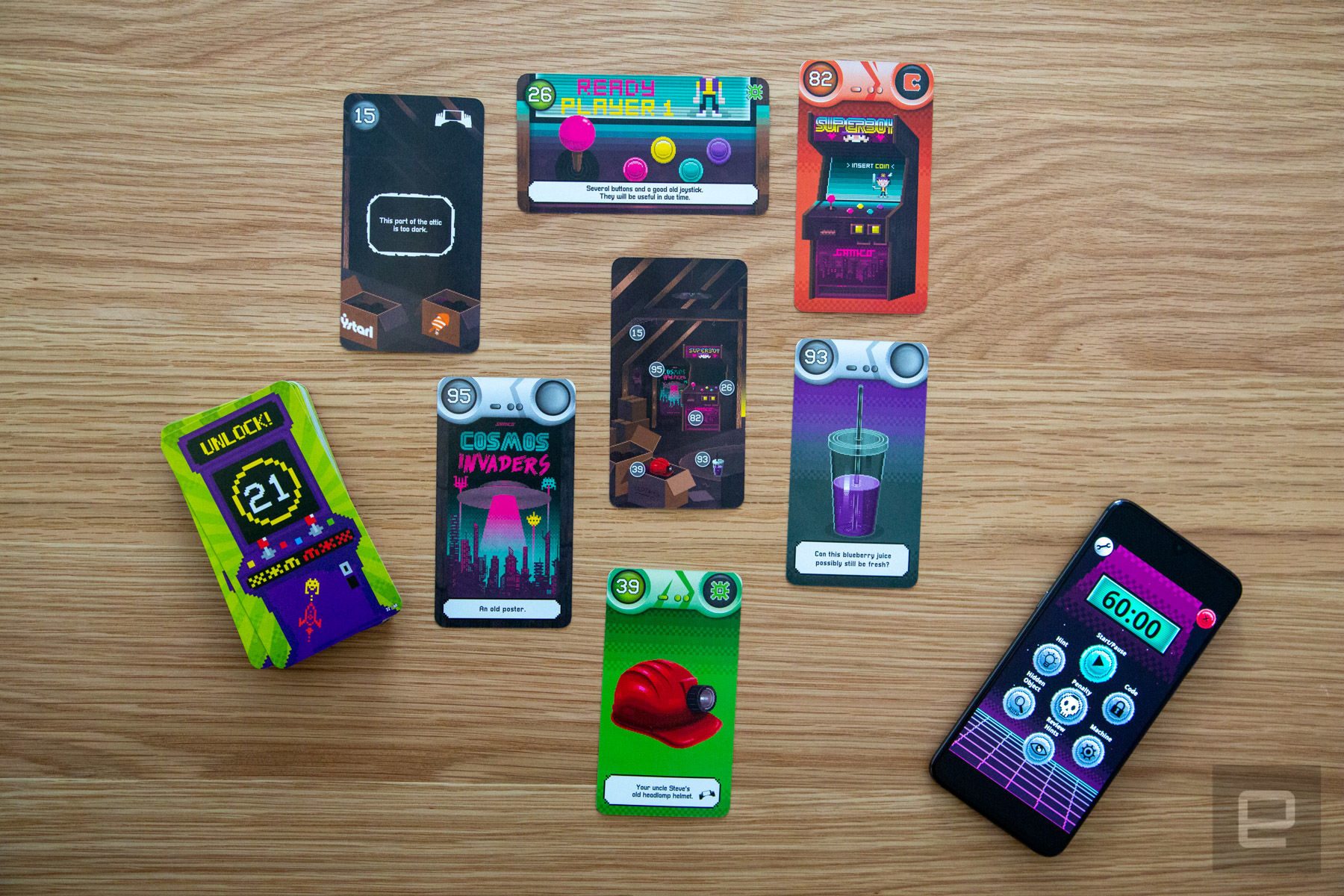
Unlock is a card game series inspired by escape rooms. Every game, or deck, starts with a card that shows the place you’re stuck in: an office, perhaps, or an attic with a dusty arcade cabinet. The picture will usually show a series of numbered objects that correspond to cards in the deck. You fish those out and inspect them for additional numbers, which provide more cards or some way to combine them. Think that key (No. 11) works with the cabinet (No. 35)? Search the deck for No. 46, and if it’s there, flip the card over to see if you’re right.
The visual puzzles slowly grow in complexity. Maybe one card has a pattern that corresponds to a diagram in another. Or should it be angled and placed over another card somehow to reveal something entirely different? You have a 60-minute time limit that’s tracked with a companion app for iOS and Android. The software is also used to enter codes that you’ve figured out, ask for hints and occasionally deploy augmented reality to reveal hidden card details. Every deck, or “escape room,” has a single solution, so there isn’t much replay value. Most come in a triple pack, at least, with varying difficulty levels to ensure the fun lasts longer than a single night.
Clank! In! Space!
Players: 1–4
Game time: 45–90 minutes
Difficulty: Medium
Get in. Get out. Clank! In! Space! is a deck-building board game that challenges players to explore the evil Lord Eradikus’ spaceship and steal as much loot as possible. At the start of your turn, you draw five cards that have different boots, blade and experience point totals. Boots let you move around the board and get closer to the “artifacts” that are necessary to win the game. Points and blades, meanwhile, let you buy better cards and vanquish foes that sit in a small Adventure Row beside the board. Once a card is taken from this repository, it’s replaced by a new one from the main Adventure Deck.
The app will guide you through the initial setup and add a mini boss that reacts to specific player milestones.
Some of your starter cards force you to create noise, or “clank,” however. These colored cubes are added to a black bag that also contains some harmless black cubes. If a card appears in the Adventure Row with the Boss Attack symbol, you have to reach into the bag and grab a number of cubes that’s dictated by how many people are playing. If any of your colored cubes are taken out, your character must suffer the same amount of damage. As the game wears on, Eradikus moves along a Rage Track that increases the number of cubes you have to pick out of the bag and how many Bounty Hunter cubes — which deal damage to everyone and stay in the bag for the rest of the game — are in play.
It’s a battle, therefore, to build up your personal deck and grab the artifacts before Lord Eradikus climbs up the rage track and starts dealing potentially lethal damage. An optional app will guide you through the initial setup and add a mini boss that reacts to specific player milestones. The software is also required if your friends aren’t available and you want to play through a five-part campaign solo. The game is better with friends — half the fun is discovering who, if anyone, is going to be hit by the next Boss Attack — but the single-player mode is still worth checking out if you want to familiarize yourself with the rules or try out some new strategies.
Star Wars: Imperial Assault
Players: 1–5
Game time: 60-120 minutes
Difficulty: Hard
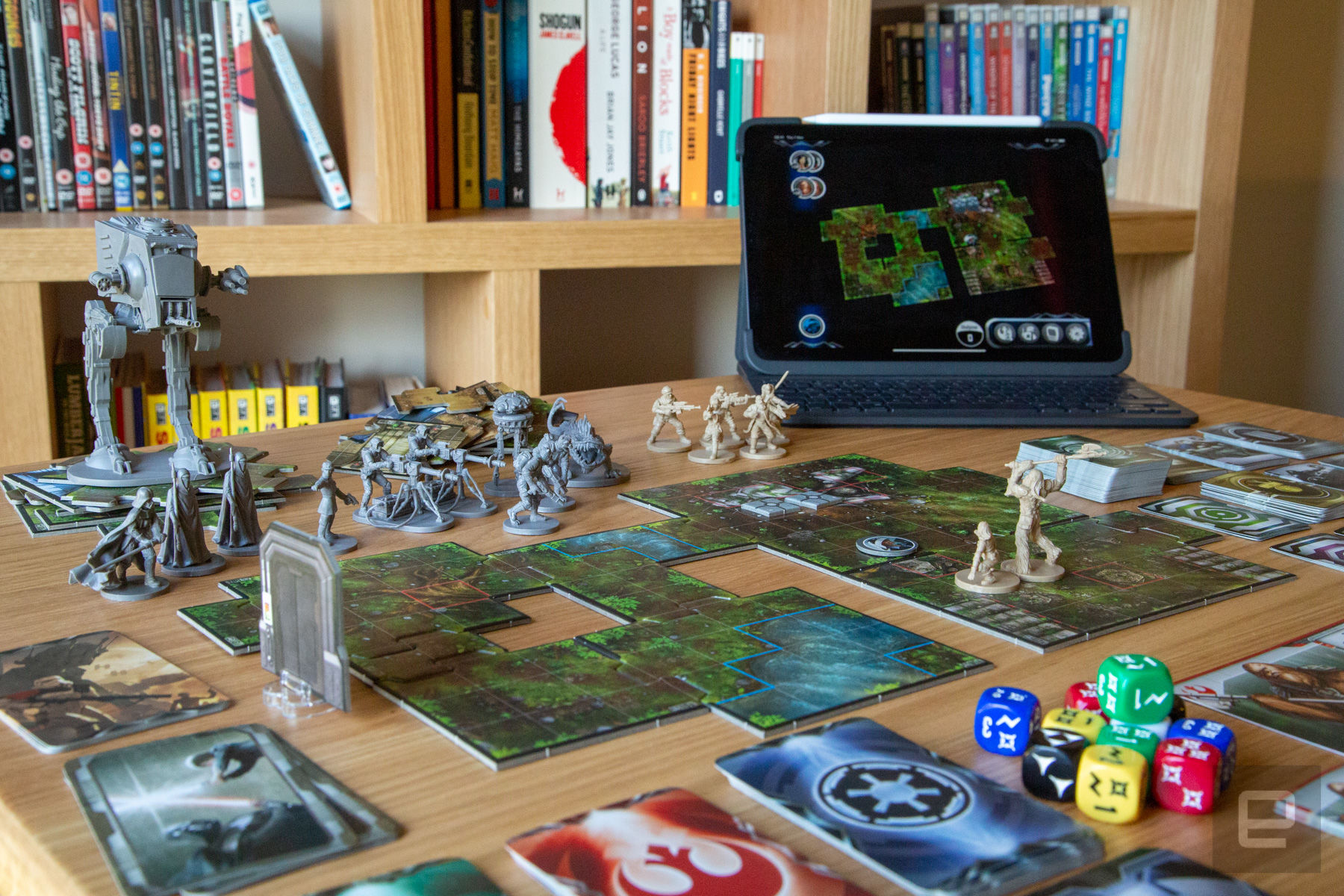
Imperial Assault isn’t the kind of game you can dig out and force random family members to play over the holidays. It’s a complex role-playing game with more than 30 figures, 10 dice, a dozen different card types and tokens that represent damage, fatigue, crates and computer terminals. Like Mansions of Madness — another top pick from publisher Fantasy Flight Games — Imperial Assault is built around a pile of double-sided tiles that can be flipped over and slotted together to create different maps. Movement, attacking with sight lines, strain and endurance — there’s a lot to learn, and you’ll need at least an hour to read the game’s many instructional booklets.
But if you love Star Wars or serious role-playing games, trust me: It’s worth it.There are three ways to play Imperial Assault. The first is the main campaign mode, which pits up to four people, each playing a different Rebel Alliance hero, against a player-controlled Galactic Empire. Alternatively, the heroes can play against the computer in a tweaked cooperative mode that uses a free companion app. The final way to play is a two-player skirmish mode that trades story-driven role-playing for tense, competitive combat. The cooperative mode is our favorite because it supports both solo and group play. The app is thoughtfully designed and guides you through individual missions as well as the character upgrades, armory purchases and side quests available in between.
Beasts of Balance
Players: 1–6
Game time: 30 minutes
Difficulty: Easy
Back in 2016, I described Beasts of Balance as “Jenga evolved.” The game comes with a circular plinth and plastic “artifacts” that include geometric animals, elemental orbs and white, cross and arrow-shaped pieces. These objects contain NFC tags that are read by the podium and reflected inside the companion app. Play the octopus piece, for instance, and it will appear inside your virtual ocean with a few tantalizing points. Unfortunately, the creature’s value will deplete and eventually disappear unless you boost it with an elemental orb or create something completely new with the “cross” and “migration” artifacts.
You can play the game solo or with a group of friends, taking turns to select and place the colored pieces. Inevitably, your column of precarious blocks will wobble and crash to the floor. The game isn’t over though! If you can reassemble the tower before a nearby volcano erupts, the world will turn a blind eye and let you keep playing. That gives you another chance to set a high score or expand the app’s Pokédex-style Bestiary.
Since the game’s original release, creator Sensible Object has updated it with optional beasts, an augmented reality mode and a competitive multiplayer battles. The company was acquired by Pokémon Go developer Niantic a few months ago, however, and has stopped actively working on the game. But it’s still being sold, and the company promised in a blog post that basic customer service and app maintenance “will continue.” If and when that changes, we’ll be sure to let you know. For now at least, Beasts of Balance still feels like a safe purchase.
Stop Thief
Players: 2–4
Game time: 30–45 minutes
Difficulty: Easy
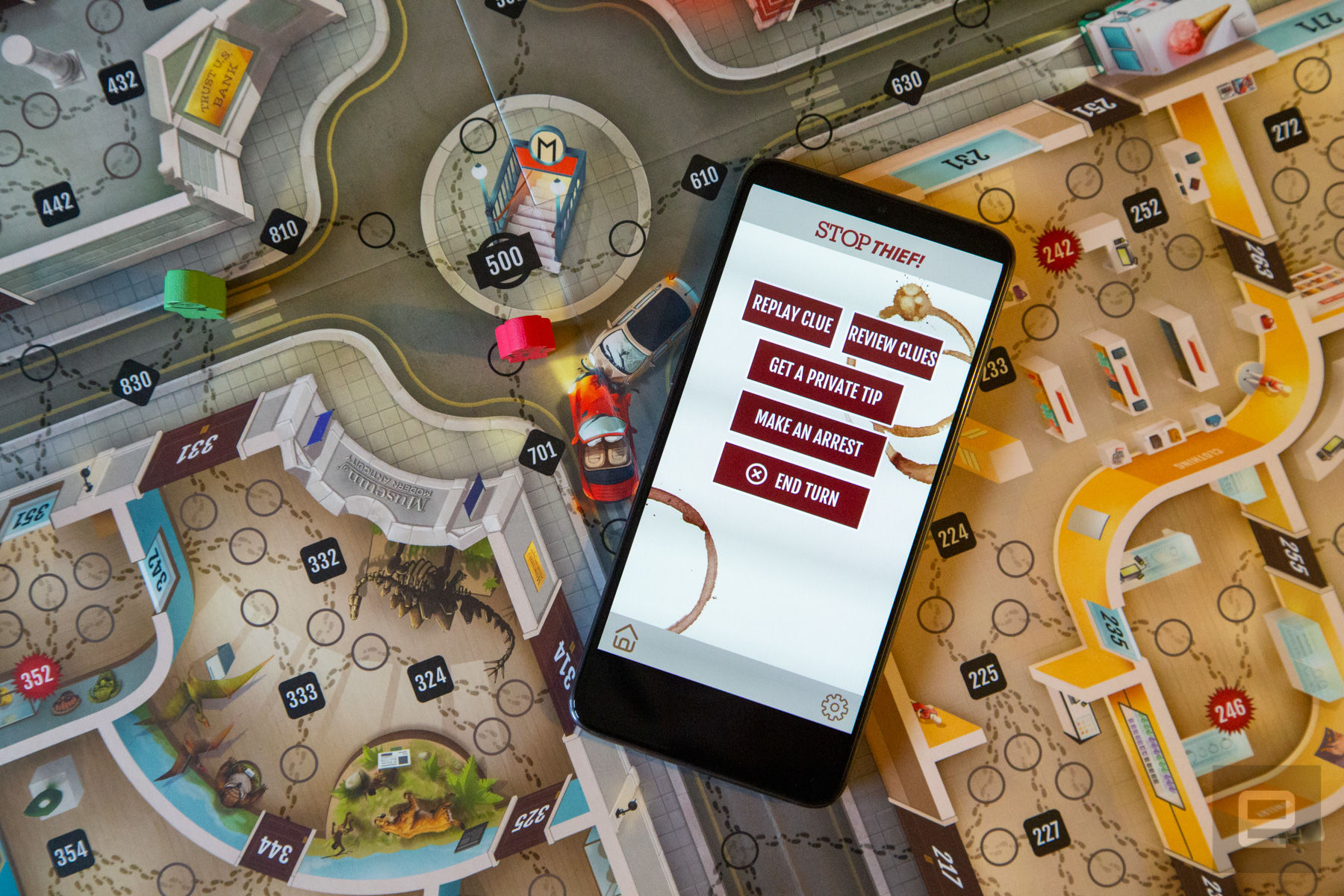
Back in 1979, rocket scientist Robert Doyle made a board game called Stop Thief that challenged players to find invisible crooks across four large buildings. An electronic Crime Scanner, which resembled an old telephone, would issue a sound at the start of every turn that explained if the thief was walking across a floor, opening a door or breaking a window. “Investigators” used the order of these sounds to narrow down the route and current location of their prey. Once they were close enough and certain of the thief’s position, players could make an arrest by typing a three-digit location number into the scanner.
An updated version called Stop Thief was crowdfunded by Restoration Games in March 2017. The basics are the same, but the bulky Crime Scanner has been swapped for a smartphone app that offers different difficulty levels, solo and cooperative modes, and a “one versus many” option that lets one player embody the thief. The physical components, including the board, player tokens and movements cards, have all been refreshed for modern times too. The core design might be 40 years old, but Stop Thief still feels fresh and, more important, fun to play. It’s an easy recommendation if you have a soft spot for police procedural TV shows.
Detective: A Modern Crime Board Game
Players: 1–5
Game time: 120–180 minutes
Difficulty: Hard
Have you ever watched a TV show like The Bridge and thought, “I could piece together a case like that!” Well, Detective: A Modern Crime Board Game gives you and up to four friends a chance to prove it. Every case starts with a text introduction and some numbered leads that can be found in a companion deck of cards. But here’s the rub: Leads take in-game time to investigate, and you only have so many hours to crack the case. Should you question the man who reported the murder or head to the lab and look over the initial forensics report for the crime scene?
It’s an agonizing choice. If the leads are in different locations, you will also need to spend an hour driving between them. Thankfully, the game comes with a tiny board that helps you keep track of your current position as well as the days and hours that have elapsed since the start of the case. Detective will also throw the occasional number at you that can be looked up on a companion website. These include suspect files, police reports and interrogation records. You can log and match “signatures” too — fingerprints on a knife handle or DNA evidence at the crime scene — to help you pin down suspects and theories.
It’s a massive but worthwhile time commitment for the hard-earned eureka moments.
It’s a fantastic concept with two frustrating drawbacks. The first is that you need a consistent internet connection to finish the game. The second is that during an Engadget play test, the website went down for several hours, forcing us to abandon the case and play something else.
When it works, Detective is sublime. The box comes with five cases that take two to three hours to complete. They form a single narrative, which means you’ll need a dedicated group — or some serious solo detective skills — to reach the end of case five. It’s a massive but worthwhile time commitment for the hard-earned eureka moments that erupt every time you realize how someone is connected to the case.
Fuse
Players: 1–5
Game time: 10 minutes
Difficulty: Easy
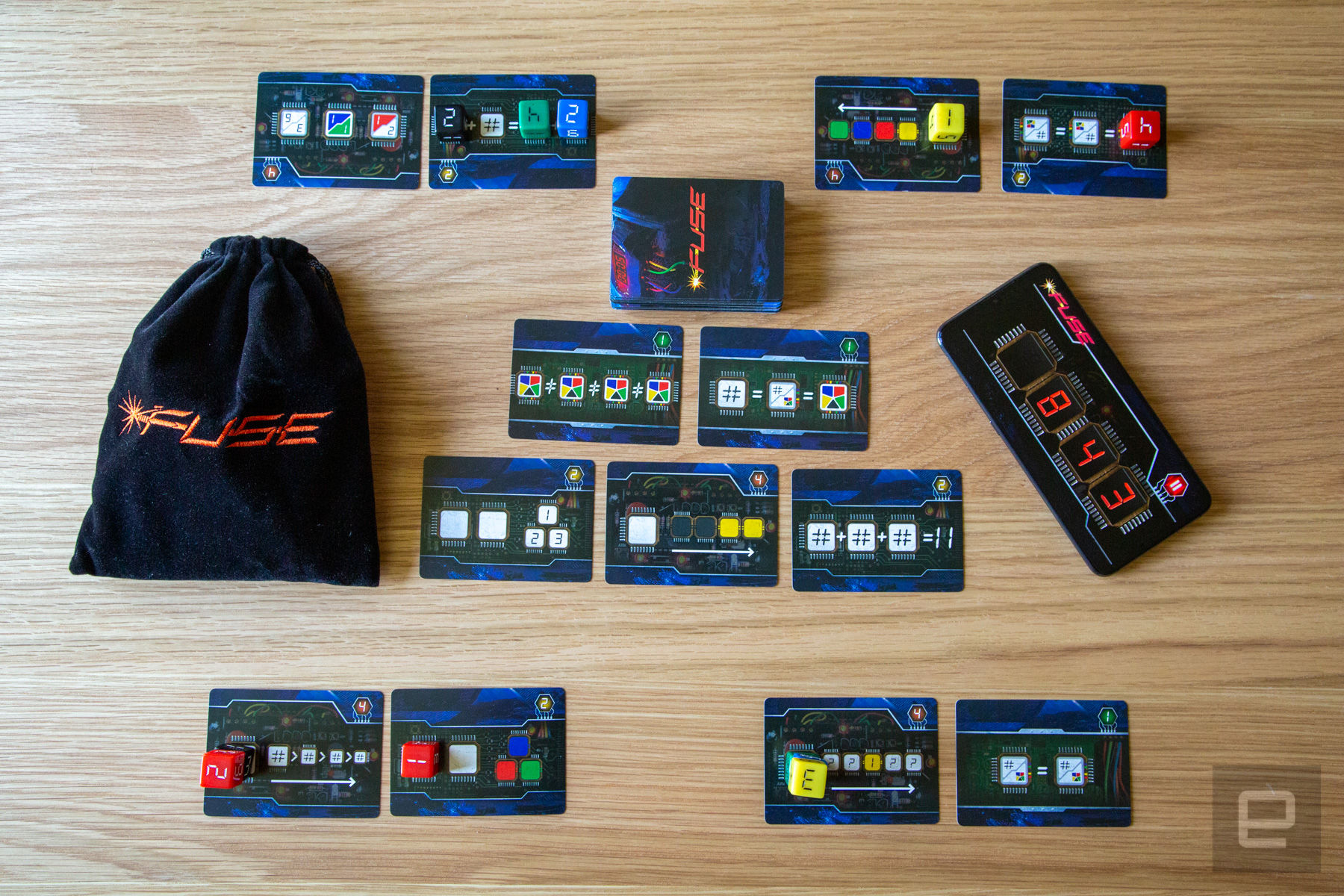
Fuse is a fast-paced bomb-disposal game that uses cards and dice instead of colorful wires and booby traps. You set up a 10-minute timer — ideally through the free companion app, which has appropriately tense background music and off-putting voice snippets (“*yawn* I must have dozed off. Still working, are we?”) — and create a small deck depending on how many people are playing and the desired difficulty count. You then flip a handful over and start rolling dice in the hope that some of them match up with what’s shown on the cards.
The make-believe explosives have different requirements that reflect the difficulty level in the top right-hand corner of the card. An easy level one, for instance, might ask for three dice of the same color or number. A tough level-four card, meanwhile, could require a tiny three-dice pyramid with red and green on the bottom and blue on top. Twenty-five dice live inside a black bag, but you’re only allowed to reach in and grab a few at a time (if you’re playing solo, the number is three). You also have to find a space for every die you roll, otherwise you have to reroll and eliminate something of the same color or number from your partially completed bomb cards.
The companion app, while basic, enhances the already frantic atmosphere and offers a basic leaderboard for tracking high scores with different-size groups. It’s a welcome reminder that sometimes the simplest games are also the most fun.
Mansions of Madness (second edition)
Players: 1–5
Game time: 120–180 minutes
Difficulty: Medium
Ghosts, amphibious Deep Ones and enormous, nightmare-inducing Star Spawns. If you’re obsessed with Lovecraftian horror and unravelling supernatural mysteries, check out Mansions of Madness. The game comes with a slew of double-sided tiles that slot together to make a creepy house. The companion app explains where to put them and an assortment of tokens that represent clues, weapons and non-player characters in each room or space.
You then have to wander around, inspect objects and slowly expand the map by opening doors and, oftentimes, unearthing secret passageways. As you piece together the mystery, the game will spawn an assortment of monsters that want to kill every character and slowly drain their sanity. Once your group has completed its collective turn, called the Investigator Phase, the app will explain how your enemies have reacted in the mansion. It won’t give you exact coordinates or tell you who to attack, however. The app might command you to move a Deep One three spaces toward the nearest Investigator, for instance, and then lash out if they’re within range.
The app doesn’t track the exact position of every player and monster in the mansion. It’s on you, therefore, to look at the physical pieces and interpret the app’s instructions. Once you’ve worked through the resulting combat — which is decided with cards and dice rolls — you update the monster’s health points through the app. The app’s partial game management can be a little confusing for newcomers. Thankfully, its limitations and the overarching rules are clearly explained both digitally and through a number of well-written booklets. The app’s limited perspective also stops players from ignoring the physical components entirely and experiencing everything as a video game instead.
Expedition: The Roleplaying Card Game
Players: 1–6
Game time: Under 60 minutes
Difficulty: Medium
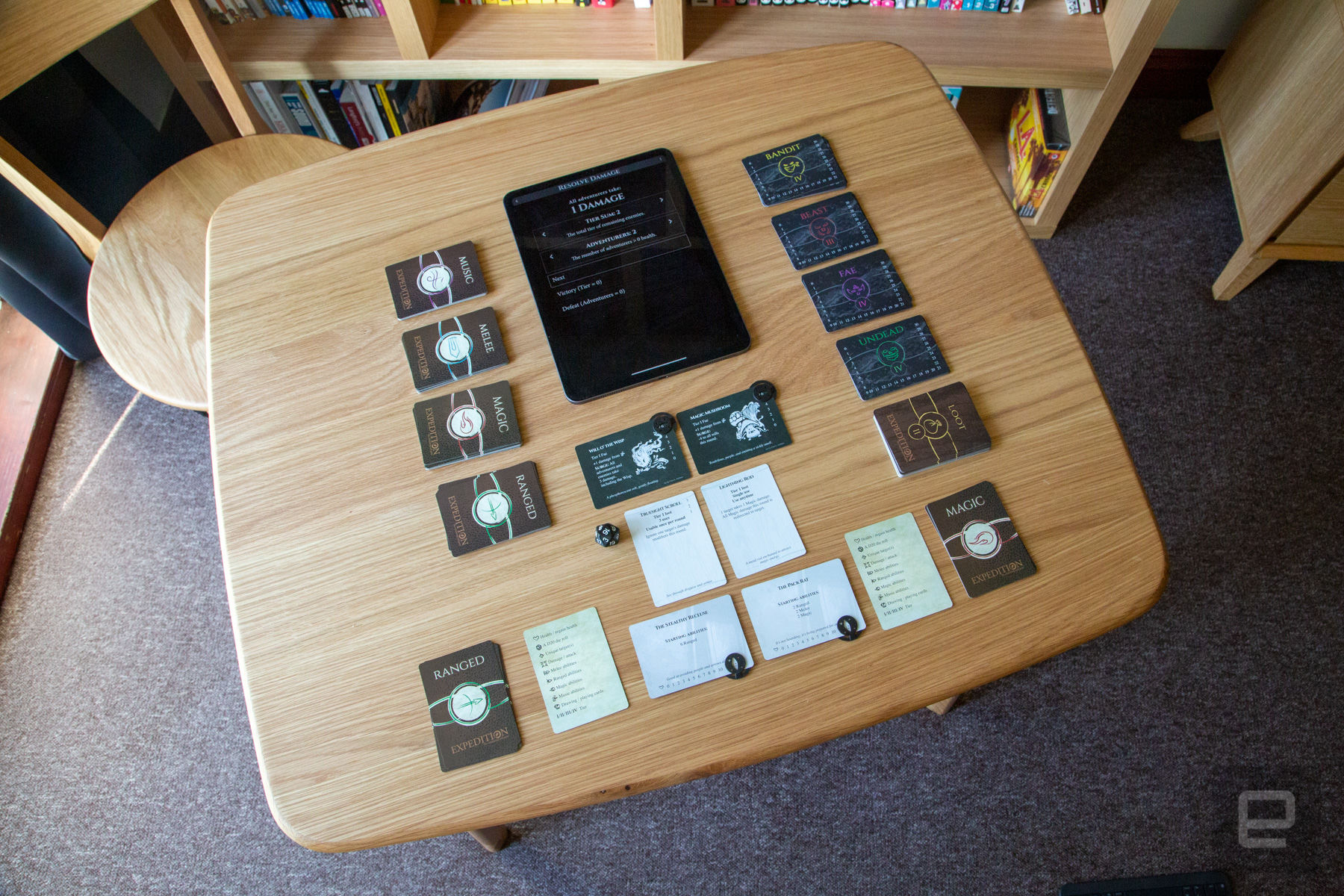
Interest in Dungeons & Dragons has skyrocketed since the game first appeared in Stranger Things. Lots of Netflix bingers want to play but have little experience with tabletop role-playing and are, understandably, apprehensive about its perceived complexity and time commitment. If you’re one of those people — or know someone who feels the same way — we suggest giving Expedition a shot. The game, originally crowdfunded on Kickstarter, condenses the experience into an easy-to-follow set of cards, dice and plastic clips. The story, which often includes a few choices and dialog options, is handled entirely by the companion app or website.
There’s no narration, so someone will have to read the text out loud. That’s the only time that someone has to take on the role of dungeon master, however, which can be useful if you’re playing in a small group and everyone wants to be a party member. The app has three official quests and over 100 more of varying quality submitted by the community. The quests crafted by the game’s creators are well written and clearly explain the various phases of battle. You don’t need much space to play, and most quests can be completed in less than an hour, leaving everyone with a satisfying conclusion before they go home. And who knows — it might just be the stepping stone your group needs to play something more complex.
The exchange encouraged community members to block deposits from the offending wallet, but didn’t have leads to identify the owner. There’s a wide range of potential candidates. It could be typical online criminal organizations, an inside job, or nation states hoping to pad their funds when sanctions leave them cash-strapped.
This isn’t the largest crypto theft to date. Coincheck lost $400 million in NEM tokens to a hack at the start of 2018, for instance. However, it’s still doing significant damage. It also suggests that exchanges may need to do more to lock down transfers to prevent large-scale theft like this.
For Engadget readers, Wellbots is discounting the DJI Mavic 2 Pro to $1,359, down from $1,729. To take advantage of this deal, input the code “SAVEDCART20” at checkout. We gave the Mavic 2 series a score of 86 when we reviewed the Pro and Zoom models last year. The highlight of the Pro variant featured in this promotion is a 1-inch CMOS sensor that allows it to capture better photos with less noise in low-light conditions. We liked that the Mavic 2 Pro was faster and had a longer-lasting battery than its predecessor. Another highlight was the variable aperture of the Pro’s camera lens, which gives you more creative control when taking a photo. Our biggest issue with the drone was its expensive price tag, something this promotion addresses.
Wellbots is also reducing the price of two separate Segway electric scooters from Ninebot. You can either get the Segway ES4 for $639, down from $769, or the more expensive Segway Max for $648, instead of $799. If you use the code “ENGADGETRIDE” at checkout you can get an additional $10 off both models, making them $629 and $638 respectively.
While we haven’t reviewed either scooter, we highlighted the ES4 as part of a back to school roundup we published earlier this year. The ES4 stood out for us thanks to its top speed of 19 miles per hour and 28-mile range, in addition to its light 30-pound weight. Another nifty feature is that you can swap the battery at any time, allowing you to easily extend the range of the scooter. The Max, meanwhile, can travel up to 40 miles on a single charge. You can also fold it for easier storage, and its entire body is IPX5-certified water-resistant, allowing you to ride it through occasional showers.