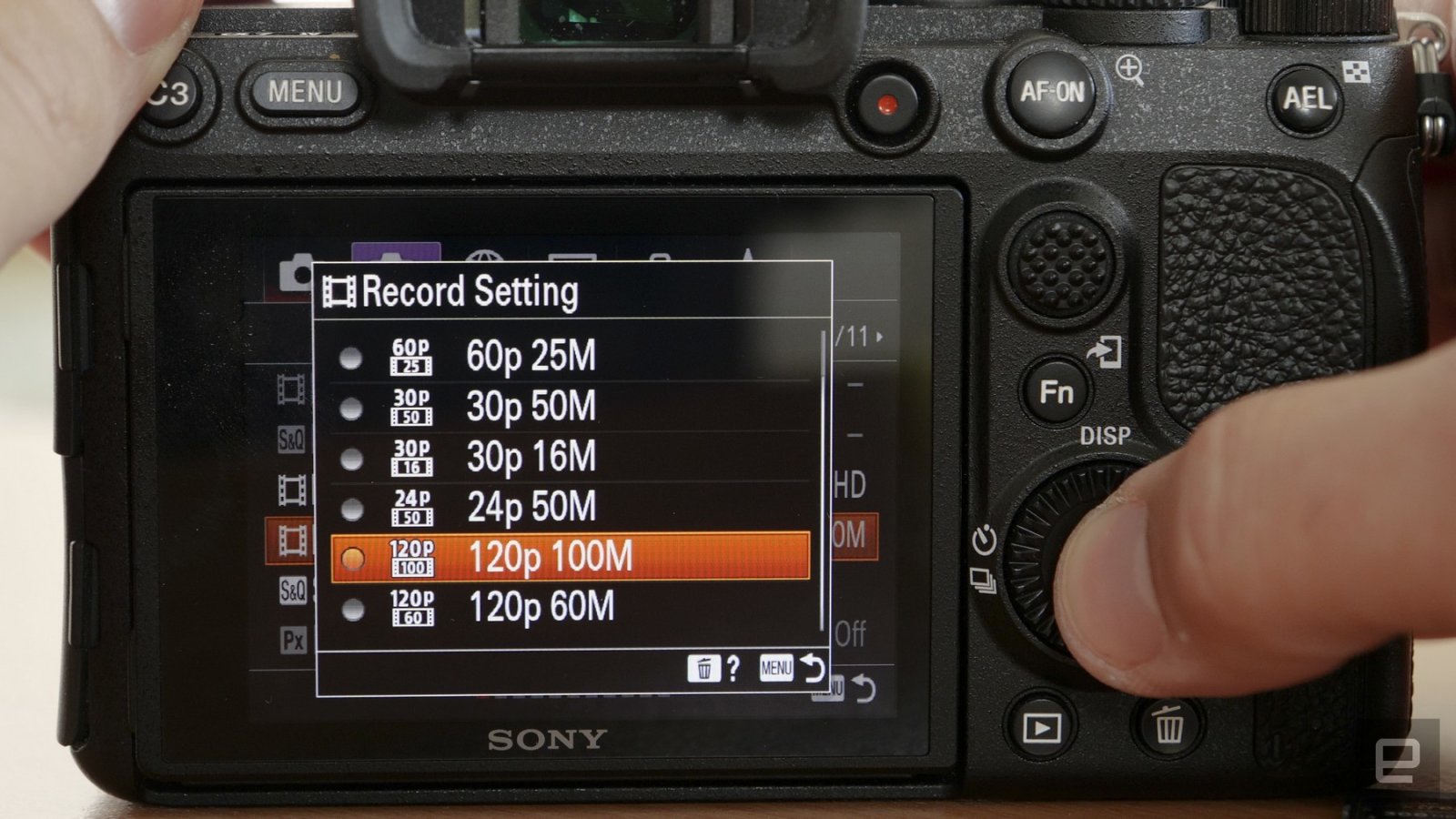
Panasonic’s S1R got it first, but the A7R IV now has a 5.76 million dot OLED electronic viewfinder. The high resolution and reasonably fast 60 Hz refresh rate make it easy on the eyes, but the A7R IV will blackout during shooting, temporarily blocking your view, unlike the freshly announced A9 II. For the type of artistic shooting it’s designed for, though, this EVF is ideal, providing an accurate preview of what you’re about to shoot.
The rear touchscreen still doesn’t flip around, so vloggers can probably tune out if they haven’t already. It’s also under-utilized. You can only tap-to-focus and drag the AF point around or use the Touch Pad option to move the AF point with your thumb when looking through the EVF. There’s no option at all to control the main menus or even the quick-access Function menu, like you can on the Nikon Z 7 or Panasonic S1R.
As for those menus, they’re still the biggest weakness on Sony’s A7-series cameras. It’s tricky to find what you need as the category organization and navigation logic isn’t, well, logical. Your best bet is to set up the camera buttons and Function menu the way you want, then stay out of the menus as much as possible.
The A7R IV has two high-speed SD UHS-II card slots, unlike the A7R III, which only had one UHS II slot and a slower UHS I slot. As I found out during action shooting, it’s best to pay extra to get the fastest cards you can afford. With a 61-megapixel sensor, uncompressed RAW files are around 120MB and even JPEG files can hit 50MB in fine mode. If you want the best shooting and transfer speeds, I’d recommend a top-flight 300 MB/s SD card.
Things keep getting better on the connection side for Sony. The A7R IV packs a faster USB Type C 3.2 connector, along with HDMI, Micro USB, headphone and microphone ports. What’s new here is the Multi Interface Shoe that opens up digital audio connections. If you hook up Sony’s ECM-B1M shotgun mic or XLR-K3M XLS adapter kit, you’ll get professional audio quality that can match any dedicated camcorder.
On the negative side, the A7R IV does let you share pictures and shoot remotely using WiFi, Bluetooth and NFC, but you have to use Sony’s Imagine Edge Mobile app. With a 2.1 rating on the App Store, it’s one of the worst camera apps out there, and that’s saying a lot. It’s pain to connect the camera to your phone and it’s laggy and unintuitive to use. Most pros who would buy this camera probably wouldn’t use it, but still, Sony needs to do better here.
It uses the same Z-series battery as before, but now delivers 670 shots on a charge with the rear display, or 530 when using the EVF, according to official CIPA ratings.That’s a slight improvement over the A7R III (650 shots), but in the real world, I was able to shoot over a thousand shots. That’s a good thing because the A7R IV is capable of shooting a lot of photos in a short amount of time.
Performance
There were times when I found myself laughing in awe of what this camera could do. You would not expect a 61-megapixel camera to be fast, but the A7R IV really delivers 10 fps speeds with continuous AF and auto exposure, even when shooting compressed RAW and fine JPEG images. If you elect to shoot uncompressed RAW, it slows down a bit to 7-8 fps, but that’s still an astonishing speed considering the image sizes.
With fast UHS-II cards, I could shoot at those speeds for a surprisingly long time. That’s thanks to a buffer that can handle 68 compressed or 30 uncompressed RAW images — about 3.6GB worth of files — in a single burst. However, the buffer took quite a while to clear, sometimes well over 30 seconds. You can review images during that break, but many settings, like full-frame/APS-C switching are unavailable.
If that won’t cut it, a flick of a menu setting transforms the A7R IV into a 26-megapixel APS-C camera with a 1.5X crop factor. In that mode, I could capture 10 fps bursts for much longer (three times to be exact), making it more useful as an action camera. The crop mode also brings you closer to your subject, turning a 200mm lens into a 300mm lens. To top it off, the resolution is an added bonus for things like wildlife photography as you can crop in a lot while retaining detail.
That speed is useless without a good autofocus system, and that’s where Sony is so far ahead of everyone else. The A7R IV now has 567 phase-detect and 425 contrast detect AF points, compared to 425 phase-detect points on the A7R III. It has more coverage (74 percent horizontal and 99.7 percent vertical in full-frame mode) and a much faster Bionz X processor, as well. By comparison, Panasonic’s S1 only uses contrast-detect AF, and the Nikon Z 7 is limited to 493 phase-detect points with 90 percent coverage total.
All that tech helped me to keep fast-moving things in focus while shooting 10 fps bursts. If I kept the tracking dot on the subject, I rarely got an out of focus shot. With those smarts and virtually no lag, the camera often had me fighting to keep up.
Luckily Sony has a cheat for that with its otherworldly AI-powered Eye AF system for people and animals. When enabled, it’ll track your subject’s eyes even if they’re relatively far away and switch to face tracking when it can’t. If your subject moves out of frame or turns around, it’ll stay locked on their head or body and switch back to the closest eye as soon as it can.
It worked in most circumstances for me, even with busy scenarios like horse jumping. With Eye AF turned on, I was able to capture sequences of jumps using Sony’s 70-200mm f/2.8 telephoto lens without any worry about focus. Unlike earlier versions of Eye AF, it rarely lost track of its subject and was a lot more responsive. It wasn’t quite as good with the horse’s eyes, especially if they had shaggy fringes. The same applied to furry terrier-type dogs.
The A7R IV is not a sports or wildlife shooter, but the extra resolution lets you shoot a bit wider than you otherwise might, then crop in to get the ideal framing. I could even see some photographers being tempted away from the more costly action- and sports-oriented A9 II.
Users will be able to live-stream games, view clips on demand and join on-screen chats. As we saw with the beta, the screen layout is similar to Twitch’s other recent apps, and as MacRumorspoints out, the app isn’t just for gamers. In addition to gaming, Twitch hosts other broadcasts, like Thursday Night NFL Games.
The soundbar is effectively a Roku Ultra built into a 32-inch audio system. In other words, it’s a one-stop shop if you want both a 4K HDR-capable streaming device and a compact TV speaker upgrade. The Wireless Subwoofer, meanwhile, augments the soundbar with 250W of extra oomph for your blockbuster movies. Neither is going to make you regret buying high-end speakers for the living room, but $258 for the combo might be an easy choice if you’re setting up a simple home theater.
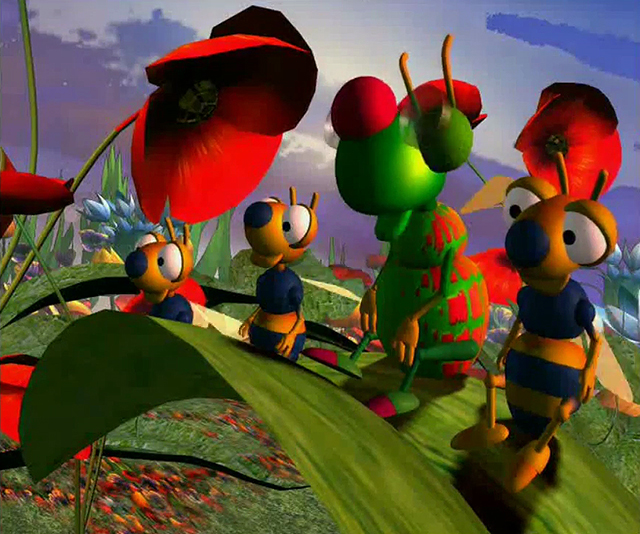
The short-lived show followed a fictional war between two insect races: the heroic and brightly colored Joyces, and the evil and monochromatic Beurks. You could appreciate most episodes on their own, but some had small story and character developments that carried over into subsequent episodes. In episode one, for instance, the heroic Fulgor receives a pollen-shooting guitar-gun that becomes his primary weapon for the rest of the show. Insektors was also a comedy that used a mix of gags to poke fun at the Beurks and their usually dim-witted foot soldiers.
Fantôme’s show had a pilot, two 13-episode seasons and a couple of special episodes. It premiered in 1994, the same year as ReBoot, and was effectively cancelled two years later. It’s unclear which came first — some believe Insektors began in April, a few months before ReBoot, while others think it debuted in December.
Regardless, Fantôme has another claim to the coveted title of ‘first computer-animated television show.’ Before Insektors, the company made Les Fables Géométriques (“Geometric Fables”), a collection of 50-or-so shorts first broadcast in 1990. Most episodes were based on fables written by the French writer Jean de La Fontaine or Greek storyteller Aesop. The characters were humorously recast, though, as geometric shapes. In ‘Le Corbeau et le Renard’ (“The Fox and the Crow”), for instance, the crow is a black box with a shallow yellow disc for a beak. The crafty fox, meanwhile, is an orange cone with a brown, spherical nose.
“We consider that we made the first CG [animated] TV series,” Gilbert Louet, one of the show’s animators and, later, the animator director for Insektors said. “It was not Insektors, but it was Les Fables Géométriques.”
Fantôme was created in 1985 by Renato, Georges Lacroix and Jean-Yves Grall. The team always wanted to specialize in 3D animation and dreamed of “eventually making a full-length animated feature film, just like Toy Story,” Lacroix told Animation World Network (AWN). The company was actually split into two parts: Fantôme Animation, which developed its cutting-edge TV shows, and a broader division that worked on TV commercials for outside clients.
According to AWN, Fantôme started thinking about Insektors in 1991. Les Fables Géométriques was nearly complete, and the team was keen “to make something higher,” according to Louet, with an epic story and characters that demanded more than a five-minute runtime. “Something much more important and serious,” he recalled. Les Fables Géométriques had run on Canal+, a premium TV channel, and France 3, one of the largest public TV stations in the country. Management at Canal+ liked Fantôme’s work and was interested in broadcasting shows that utilized new technology and effects.
The credits that scroll at the end of every episode reveal that Renato came up with the original idea for Insektors. He’s also listed as one of the show’s creators alongside Lacroix. In 1992, the team created a video that served as both a pilot and ‘making of’ documentary. The dual format was likely meant to impress broadcasters but also explains some of the unique technical challenges they would be facing. At the time, computer animation required expensive hardware and software licenses. Securing the necessary budget was, therefore, no simple task in France.
With the show approved, Fantôme looked for a scriptwriter that could develop its ideas into a structured season. The company asked animation studio Ellipse Programme, one of the project’s co-producers, for help and gained an introduction to Eric Rondeaux. The writer had worked with Ellipse on The Adventures of Tintin (1991), a well-regarded adaptation of Hergé’s iconic comic books. “I was a huge fan of Hergé,” Rondeaux told Engadget. “I think he’s kind of a genius.” The show’s quality can be attributed, in part, to Rondeaux’s unwavering commitment to the source material. “Sometimes I had to fight against the production company to get closer to the books,” he said.
“[It] wasn’t very sophisticated in its universe and characters, but it was lots of fun.”
The writer liked technology and was aware of how CGI was developing in both the film and TV industries. But he had no experience with computer-driven animation. “I knew what it was,” he explained frankly. “The idea, and intellectually. But I had no experience. Nobody [at Fantôme] had any experience! Well, almost.”
Rondeaux agreed to meet with Fantôme and thought the concept for Insektors sounded “very cool” and exciting. The insect war was a simple idea — a classic tale of good versus evil — but flexible and intriguing. “It had to be [simple],” Rondeaux explained, “because we couldn’t afford to be too sophisticated. So [the show] wasn’t very sophisticated in its universe and characters, but it was lots of fun. Because we knew we had these technical limitations.”
Fantôme held weekly writing workshops to develop the stories and eventual scripts for each episode. The group included Rondeaux, Renato and, later, two additional screenwriters, Marc Perrier and Veronique Herbaut. “Obviously, I couldn’t write all of the series,” Rondeaux said. The writing team would spend the day conceiving and discussing ideas. Each member would then split up and work in isolation before reconvening the following week. This writing setup is common in the movie and TV industry, but Fantôme didn’t know that.
“We had no idea about workshops or things like that,” Rondeaux admitted. “We did all of that by instinct. It was natural, in a way, to work that way. And now it’s all about that in France: ‘We should work in workshops, we should do as [the] Americans [do].'”
The company then had to bring its ideas to life. Ferdinand Boutard, a former animator at Fantôme, said the director(s) — typically Renato and Lacroix — and Louet would assign everyone shots to animate. Management would then review those shots, give time for adjustments and review them again. If an animator did good work, they would be given more difficult and creatively stimulating shots next time. Conversely, animators who struggled were given simpler and likely more boring shots.
“[Louet] always tried to give you a shot that matched your skills,” Boutard said.
Fantôme used hardware built by Silicon Graphics, a California-based company that initially specialized in 3D graphics computer workstations. According to the Fantôme website, these included the low-end, electric-blue Indy workstation; the larger and more capable Indigo, along with its eventual successor, the Indigo2, and the Challenge L and XL multiprocessor server computers.
Boutard said they were “slow” but “ordinary” machines for the time. “Not the best ones,” he told Engadget. “[But] not the worst.”
The company had used a piece of software called Explore, developed by Thomson Digital Image (TMI), to create Les Fables Géométriques. According to Louet, the software was great for modeling, texturing, lighting and rendering. “But not for animation,” he explained. “[For that] it wasn’t so sophisticated. We wanted to make complex animation and Explore wasn’t easy for doing that.” To solve this problem, the team exported its models into a second piece of software called Softimage 3D, which was better for animation. The program was commonplace in the industry and had been used for digital effects in Hollywood movies such as Alien 3 and Jurassic Park.
Once Fantôme had completed the animation, the data was imported back into Explore. “It was a strange pipeline, but it worked,” Louet said.
Fantôme targeted two to five seconds of animation per person per day, according to Louet. That meant working some long and gruelling hours. Boutard joked that animators “were just like mercenaries.” They would eat together and take turns to cook for one another. Staff would also work through the night to hit deadlines and deliver the show on time. It was a hard but necessary routine to realize the company’s dream. “This is the right way to do things,” Boutard said. “[Pushing] forward! But doing one [thing] after another. In the right order.”
Insektors is unique in having two wildly different English dubs. The first, designed for North America, made a few minor changes — the Beurks are called Yuks, for instance — but mostly stuck to the original French scripts. The other dub, meant for the UK, altered reams of dialog and switched up almost every name and fictional term in the show. “It wasn’t the same dialogue, but it was funny too,” Louet said. The Joyces became the Verigreens, for instance, while the Beurks/Yuks — now known as Kruds — have names like Lord Draffsack, General Wasabi and The Methane Brothers, or Miff and Eric.
The biggest difference between the two English dubs, though, is the voice actors’ deliveries. In the UK version, almost every character has a heavily regionalized accent. Some mimic Welsh and Yorkshire citizens, while others imitate the Queen-like pronunciation of southern England. These choices compliment the dialogue changes. In the opening episode, for instance, a grumbling bug says with a Lancashire twang: “Call this a concert? I’ve had more fun at Wigan Job Centre.” Later in the season, Godfrey, the wise but eccentric Verigreen leader, shows Flynn a seed that can instantly spawn beautiful flowers: “I’m thinking of entering it into the Chelsea Flower Show,” he says with perfect received pronunciation.
There’s no definitive version of Insektors. Many of Fantôme’s former employees are fond of the UK dub and its regionalized accents, though. “That was a very good idea that we didn’t have in France,” Rondeaux said. “I regret that we couldn’t do that kind of thing [over here]. Because we don’t use regionalized accents in France. But I think that’s a mistake.”
The Musical Color Gun
Season 1, Episode 1
Fantôme was aware of ReBoot, but it’s not clear if the company had any relationship or direct correspondence with Mainframe. “After work we watched some [animated] features and other things,” Louet recalled. “About ReBoot, we think it was not so… so beautiful.”
“About ‘ReBoot’, we think it was not so… so beautiful.”
According to the animation director, Insektors was broadcast first on Canal+ in France. The channel requires a subscription, which meant the episodes, despite being shown in a primetime evening slot, had a limited audience. After six months, the show aired on France 3, a mainstream entertainment channel that’s free to watch. That should have been Fantôme’s big moment, at least domestically, but Insektors failed to break out and become a massive hit.
Rondeaux believes that France 3 was partly to blame. Early in the show’s production, he attended a meeting with the channel’s head of youth programming and tried to explain the concept both narratively and technically. “She told us something like, ‘You know guys, I don’t understand anything. I don’t get anything that you’re talking about. I just trust you, do whatever you think is good. But I don’t get it,'” Rondeaux recalled. The broadcasters were supportive and thrilled by the idea of making the first computer-animated show. “But they didn’t know what to do once they had it,” he said.
According to Rondeaux, the executives didn’t realize or believe that adults would appreciate the show’s humor. That created some confusion about when to air the show on France 3. “If you broadcast it at 8 o’clock in the morning, just before the kids go to school, you’ve missed the point,” Rondeaux said. “You’ve missed your target. I think that’s what they did. I think that’s why the series didn’t go [down] so well in France.”
The show was a critical success, though. Throughout its two-season run, Insektors picked up more than 30 awards, including an International Emmy Award in the Children and Young People category in 1994.
The reaction was large enough to secure a second season. Like the first, it had 13 episodes that ran for 12 minutes each. (ReBoot episodes, for comparison, were 23 minutes long.)
The production had one major difference though: motion capture. In the early 1990s, Canal+ bought a production company called MediaLab, which specialized in the technique. According to Louet, Canal+ effectively mandated that Fantôme utilize its newly acquired asset to make Insektors season two. “They paid [us partly] with services,” he explained. “With this company.”
Fantôme had already bought a motion-capture system by Polhemus and done some exploratory tests. “I remember that I was not convinced of this technique,” Louet said. “I always preferred keyframe animation.” Still, the team went along with Canal+’s demands. Louet became a supervisor for the motion-capture work and spent roughly half his time at the MediaLab office in Paris. Like Fantôme, the company used an electromagnetic Polhemus system to track objects in three-dimensional space. According to Louet, two people were required to capture a single Insektors character. One person acted as puppeteer, moving the head and associated features, such as the eyelids, mouth and, depending on the insect, antenna. An actor, meanwhile, became the body.
It wasn’t perfect, but the two companies were able to produce enough motion-capture data for roughly one episode each week.
Back at Fantôme, Renato and Lacroix continued to push the team and slowly assemble the show. Magali Rigaudias, one of the company’s animators, remembers Lacroix as a “pioneer” and driving force behind the company and its technological capabilities. “He was extremely passionate about 3D and the work that his company was producing,” Rigaudias said. Renato, meanwhile, took on a broader creative role. Boutard said he was “a really nice guy” but also comprehensive and clear in his vision for each scene.
Together, they made a great team. Behind the scenes, though, the pair were fighting to keep the show and their company alive. Louet remembers how difficult it was for Lacroix to talk about the show’s budget with broadcast executives. “Because each time we came back to see Canal+, they [would] say ‘Okay but now it’s too expensive, so you have to do it cheaper,'” Louet explained. Fantôme had already agreed to motion capture as a way to cut costs. The team’s hardware and software preferences, however, meant the show was more expensive than a traditional 2D-animated series.
As the team worked on season two, it soon became clear that the broadcasters wouldn’t be approving a third. “We were all hoping for a third season, or maybe a feature film, but unfortunately it didn’t happen,” Rondeaux said. “For a lot of reasons, very complex reasons that I can’t really explain.” The team was able to make a Christmas special, though, which was released in 1996. It also secured another project, Tous Sur Orbite (All On Orbit), which taught children about the solar system. Like Les Fables Géométriques, these were short episodes that didn’t stretch the company’s storytelling abilities.
The Prince of Rock
Season 1, Episode 9
After that, the company seemed to crumble. Lacroix, Louet and other Fantôme members experimented with a series called Les Girafes de Mordillo (The Giraffes of Mordillo), which was based on the work of Argentinian cartoonist Guillermo Mordillo. Only two episodes were ever made.
By 1998, the studio was desperate. Lacroix asked for help at a press conference held at the IMAGINA computer graphics festival in Monte-Carlo, Monaco. As AWN magazine reports, the company had been unable to secure the necessary funding for Les Girafes de Mordillo and was now facing closure. Fantôme had struggled, according to an article by Stephane Singier, because there weren’t enough clients beyond Canal+ prepared to take the financial risk. “No European bank wanted to invest in the 3D sector, which is looked upon like a circus act,” she wrote in AWN‘s March issue.
“No European bank wanted to invest in the 3D sector, which [was] looked upon like a circus act.”
The following month, Lacroix published an open letter asking two French ministers to save the country’s 3D-animation industry. He said that the government’s “lack of awareness” had caused “several firms to close” and allowed promising software to be sold to American and Canadian companies. “Numerous films using these new technologies have had difficulties finding financing and some have had to be abandoned,” Lacroix wrote. The Fantôme founder then recapped his company’s shows, including the awards and revenue they had earned. “In spite of these creative and productive capabilities, in spite of its project slate, its international reputation, prestige and enormous potential, Fantôme could disappear, along with other firms who can’t find the necessary ingredients for growth in France,” he wrote.
The letter didn’t seem to make a difference. Fantôme was sold to a Belgian producer and distributor called Neurones in 1999. According to Playback magazine, the studio’s new owner wanted Fantôme to pursue its dream projects including an Insektors feature film and a complete series of Les Girafes de Mordillo, consisting of 50 roughly one-minute episodes. Neurones kept six Fantôme employees and asked Lacroix to stay on as the studio’s artistic director. Neither project came to fruition, though, and the Fantôme name quickly faded into obscurity.
“Fantôme was dismantled,” Rondeaux said. “It disappeared.”
Insektors The Game
Special
Insektors never had an official video game. Fantôme made a roughly five-minute short, though, about a young boy who plays an interactive version of the show. It’s set in 2001 and starts with the main character, Jeremy, controlling his computer with a pointer and VR glasses. The rebellious youth watches a video message from his mother that prompts him to complete some homework. He disobeys her order, though, and plays a portion of an Insektors game using a long, baton-style controller instead. At the end of the short, Jeremy’s mother pops up inside the game and scolds him for deliberately procrastinating.
Insektors only ran for two seasons. ReBoot, by comparison, had four during its original run and was revived last year as a live-action and computer-animated hybrid for Netflix. Unlike Fantôme, Mainframe still exists and, with its sister company Rainmaker, continues to produce a mix of TV shows and movies, including Spider-Man: The New Animated Series in 2003 and the Ratchet and Clank film from 2016.
Fantôme never made a full-length feature film. Some of the company’s employees, though, have pushed on and realized that dream in subsequent roles. Eric Guillon, for instance, has spent the last decade as a character designer for countless Illumination Entertainment movies including Despicable Me (yes, he invented the Minions), The Lorax, The Grinch and The Secret Life of Pets 2. Insektors, then, still has an influence to this day. And those who worked at Fantôme will always remember with fondness their time at the company.
“The team culture was fantastic,” Rigaudias said. “In fact, I’m still friends with most of the people I worked with back then.” Rondeaux added: “Sometimes when you look back, everything [seems] very nice, and you forget all the bad things. But honestly, [Fantôme] was really nice.”
Another big new feature on the PS4 system update 7.0 is Remote Play on all smartphones and tablets running Android version 5.0 or higher, and not just Sony Xperia devices. That means the feature is now on all major platforms, as iPhone and iPad devices got it earlier this year. Remote Play has also been updated for iOS devices “so you can now display the controller at all times and lock the screen orientation,” said Sony in its blog post.
Furthermore, players can now use Dualshock 4 wireless controllers over Bluetooth on Android, iOS and Mac via new updates in Android 10, iOS 13, iPadOS 13 and macOS Catalina coming later this month, Sony noted. The update is arriving around the world this week, so you should see it on your console soon.
Deepfake videos have become more convincing as of late, especially recent ones from Ctrl Shift Face that show comedian/actor Bill Hader’s face replaced by Tom Cruise. Those are amusing, but other deepfake software — like those that places the faces of actors like Scarlett Johansson onto the bodies of porn stars — are a disturbing invasion of their privacy.
On the political side, a deepfake video was doctored in a different way to make it seem like House Speaker Nancy Pelosi was drunk and slurring her words during a speech. At the time, Facebook refused to remove the video, saying it would instead display a third-party fact-checking article highlighting the fact the it had been edited.
California Assembly representative Marc Berman said that such videos could deceive the public and affect election outcomes. “Voters have a right to know when video, audio, and images that they are being shown, to try to influence their vote in an upcoming election, have been manipulated and do not represent reality,” he said in a press release. “[That] makes deepfake technology a powerful and dangerous new tool in the arsenal of those who want to wage misinformation campaigns to confuse voters.”
The American Civil Liberties Union, however, took issue with the law. “Despite the author’s good intentions, this bill will not solve the problem of deceptive political videos,” it said in a letter to Newsom. “It will only result in voter confusion, malicious litigation and repression of free speech.”
Vodafone has so far only deployed OpenRAN in Turkey, where it provides 2G and 4G service. This represents a significant expansion, and the company isn’t moving slowly. It plans to roll out the open radio tech in 120 rural UK areas on October 7th. It’s also expanding to more countries with trials in the Democratic Republic of Congo and Mozambique.
Whether or not carriers use this to lower prices isn’t guaranteed. It’s entirely feasible that networks will either roll any savings into upgrades or simply pad their profit margins. This at least raises the possibility of lower prices, though, and might help coverage for carriers with tight budgets.
OpenRAN could help with perceived security issues, too. Whether or not there’s any legitimacy to claims that companies like Huawei could use equipment to surveil communications, carriers would have an easier time sidestepping the issue — they’d have more alternatives to consider.
Musk added that he “will consider” allowing custom upload sounds, although we can imagine that being problematic if drivers decide their horns should blare colorful language. Tesla might also be bound by regional requirements for specific movement sounds to alert pedestrians.
You might not have to wait if you’re determined to get a Monty Python fix in a Tesla. One Model 3 owner has discovered that naming his car after Holy Grail‘s daunting Rabbit of Caerbannog created a Tesla Tesla Theater shortcut to Monty Python videos on YouTube. Electrek also found references in the Tesla Android app’s code to a currently unavailable “Patsy Mode” (named after Arthur’s sidekick in Holy Grail) that could play the coconuts when you summon your car from Auto Park. Things are about to get very silly in your EV, then, whether or not you’re actually moving.
Blix has previously accused Apple of unfairly suppressing Blue Mail. It claimed that Apple’s acknowledged problems with App Store rankings pushed Blue Mail down to 143rd in search results (it’s since back to 13th). It also disputed Apple’s statement that it removed Blue Mail from the Mac App Store for supposedly copying another program, TypeApp. The developer said that TypeApp had been voluntarily removed and that Apple was promoting market monopolization by limiting the number of competing apps.
It’s too soon to know who will prevail. If Blix succeeds, though, Apple faces both an injunction as well as damage claims. It wouldn’t necessarily have to modify Sign in with Apple, but it might have to compensate Blix to keep using the privacy-minded concept.
The questioning is part of a larger EU effort to determine if and how Libra should be regulated, provided it’s even allowed to operate in the region. There are significant hurdles to that happening. The European Central Bank’s Benoît Coeuré has warned that the standards for approval “will be very high,” and the French government has argued that Libra shouldn’t be allowed in the EU.
This doesn’t mean Libra will be rejected. Some European politicians argue the virtual money could be useful for cross-border payments. However, regulators have been hoping for a truly EU-wide agreement, since clearance in one EU country could effectively make the currency viable across Europe.
The timing isn’t certainly great for Facebook when Libra just lost backing from PayPal. While Facebook isn’t expected to run into more trouble with its partners (they’re expected to sign a membership declaration by October 7th), the combination of the departure with EU questioning is bound to raise doubts about the viability of the digital monetary format.