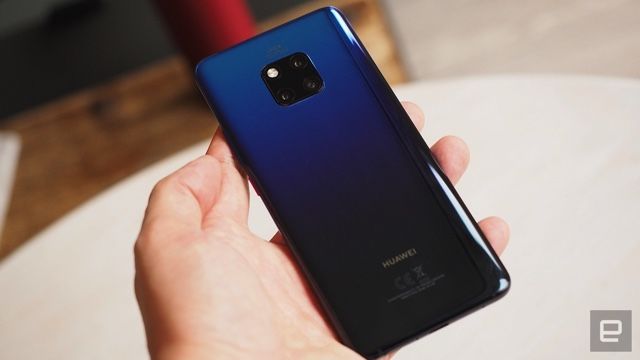
According to Huawei, the US has instructed law enforcement to “threaten, menace, coerce, entice, and incite” current and former Huawei employees. Huawei says the US has unlawfully searched, detained and arrested Huawei staff; sent FBI agents to employees’ homes; dug up old civil cases that have been settled; and committed various other wrongdoings. (The full list of accusations is copied below.)
An unnamed source told The Wall Street Journal, that at least three employees from Huawei’s US office have been contacted by US law enforcement agencies this year. But as the WSJ points out, it’s not uncommon for FBI agents to visit current and former employees of a company that’s under investigation. In addition to national security concerns, the US is reportedly investigating new allegations of intellectual property theft.
Huawei’s accusations were made in a somewhat unrelated press release, which was meant to refute separate charges that Huawei committed patent infringement. Late last month, the WSJ reported that the US Department of Justice probed Huawei over allegations that it stole intellectual property patented in the US. In its press release today, Huawei said those allegations are false.
“We strongly condemn the malign, concerted effort by the US government to discredit Huawei and curb its leadership position in the industry,” Huawei wrote. The company has repeatedly denied accusations made by the Trump administration, which has said that Huawei is at the mercy of Chinese government officials. But this is the first time since the US blacklisted Huawei, that the company has released its own list of accusations.
Huawei’s allegations, as they appear in the press release, are copied below:
Instructing law enforcement to threaten, menace, coerce, entice, and incite both current and former Huawei employees to turn against the company and work for them
Unlawfully searching, detaining, and even arresting Huawei employees and Huawei partners
Attempting entrapment, or pretending to be Huawei employees to establish legal pretense for unfounded accusations against the company
Launching cyber attacks to infiltrate Huawei’s intranet and internal information systems
Sending FBI agents to the homes of Huawei employees and pressuring them to collect information on the company
Mobilizing and conspiring with companies that work with Huawei, or have a business conflict with Huawei, to bring unsubstantiated accusations against the company
Launching investigations based on false media reports that target the company
Digging up old civil cases that have already been settled, and selectively launching criminal investigations or filing criminal charges against Huawei based on claims of technology theft
Obstructing normal business activities and technical communications through intimidation, denying visas, detaining shipment, etc
In case you’ve forgotten since the last time we all talked about Android 10, there are plenty of new features to try out here. Android now has a system-wide dark mode, for one, which should ease the strain on your eyes and on your Pixel’s battery. Google also overhauled its gesture navigation scheme (again), and while you don’t have to use these tweaked controls, it’s still interesting to see how Google thinks we should be interacting with our Android devices.
Sharing links and content should be a lot more elegant this time around, and Google’s new Focus Mode should make it easier to silence certain apps while you’re trying to get work done. Oh, and this version of Android packs full support for foldable like the Galaxy Fold, though it’ll be a while yet before we actually get to see what’s new on that front.
Of course, Google baked a slew of new security and privacy features into Android’s core too. Some, like more insistent permission controls for your device’s location, will be pretty hard to ignore. Many others, though, like Google’s push to compartmentalize certain Android components for faster updates through the Play Store, should be much less intrusive.
Unfortunately, even Pixel owners will have to wait a little longer to try out some of the features Google showed off at its developer conference earlier this year. Live Caption, which automatically converts audio into on-screen text, will launch later this fall on Pixels before rolling out to a handful of other devices. At this point, we’re not exactly sure what’s going on with the super-fast, shrunken-down Google Assistant the company demoed on-stage in May either — we’re installing the final build to see for ourselves, but we’re not holding our collective breath. All told, though, there’s a lot to dig into once you’ve installed the update, and we wouldn’t be surprised if you’ve stopped reading by now to get a feel for everything yourself.
If you own a GM vehicle that is a 2006 model or newer, it’s likely it has OnStar hardware installed. Car owners who no longer pay for OnStar can still access the service for free during the hurricane. Advisors will be available to assist 24/7.
GM isn’t the only automaker providing natural disaster support. Tesla is helping those impacted by Hurricane Dorian by offering free Supercharging, enabling Powerwall’s “storm watch” feature and enabling more range on some vehicles. Electreknoted that owners of a Powerwall — Tesla’s lithium ion battery — who were in Dorian’s path noticed that storm watch mode had been activated. The special emergency mode automatically charges the Powerwall at full capacity so it can provide backup power.
The Category 3 hurricane is expected to get close to Florida’s east coast by Tuesday evening and last through Wednesday. And local government and emergency services appear to be taking it seriously. “Hurricane Dorian is the strongest storm to ever threaten the state of Florida on the east coast,” said Jared Moskowitz, director of Florida’s Division of Emergency Management. “No matter what path this storm takes, our state will be impacted.”
Content overseers are apparently moving quickly, too. The nearly 30,000 videos pulled for hate speech in the past month produced only three percent of the views that knitting videos did.
The service also used the news as an opportunity to boast about its automated video flagging. Machine learning was the first to catch 87 percent of the 9 million videos removed in the second quarter of 2019, and more than 80 of automatically flagged videos were removed before anyone saw them. Improved spam detection saw a 50 percent jump in the number of channels pulled for violating relevant policies.
The company did acknowledge the trickiness of applying AI to hate speech, though. It noted that categories like that are “highly dependent on context” and need human review to make appropriate decisions. YouTube’s crackdown on hate speech inadvertently pulled history videos and channels that were merely educating people on Nazis and World War II, for example — clearly, the technology wasn’t clever enough to make the distinction.
The achievements won’t please everyone. In addition to those videos that might slip through the cracks, there have been concerns that YouTube might be stifling free expression with the aggressive takedowns. Critics have asserted that allowing hateful videos puts the perpetrators out in the open where they can be challenged and, ideally, steered away from their extreme views. However, YouTube and others don’t see it that way — they’re worried about the potential for radicalization, not to mention the possibility these videos will show up in recommendations attached to more innocuous clips. YouTube doesn’t want to take any chances, and that means pulling content en masse.
You might not need extra gear depending on your artistic inclinations. It includes two 50W speakers to pump out music all on its own, and a 3,000mAh battery will keep it running when you’re nowhere near a wall outlet. This isn’t a completely stand-alone instrument, to be clear — you’ll want to use either a digital audio workstation (it’s compatible with apps like Ableton and GarageBand) or Rhythmo’s own smartphone app to complete your music production workflow.
It shouldn’t take long to get one in your hands, at least. Provided all goes well with crowdfunding, you could get a unit as early as spring 2020. It might come just in time to help you soundtrack a few summer parties, or to help teach kids the ins and outs of electronic music making. And those are really the goals — this is an entry point and educational tool for people who have little to no experience with creating music.
Surfbort is the music the world needs right now: screaming about anxiety attacks, plastic in the ocean and Trump’s tweets. There’s a chance you’ve heard of the four-person, Brooklyn-based group. It’s been around since 2015, played SXSW a few times and has been called “one of New York’s last (only?) great punk bands.” This spring, it was part of Gucci’s pre-fall 2019 campaign, and lead singer Dani Miller was the “unconventional” face of Gucci’s debut beauty collection.
The band has been described as thrashy and feverish. The Guardian called it a “buzzy garage group fighting Trump and triumphing in the face of trauma.” Miller, the band’s only lady, has been called the “friendly, burrito-puking queen of punk” (she started the band as a joke and once threw up a burrito during a set). Bandmates Sean Powell, Alex Kilgore and David Head all got their start raging in the ’80s Texas punk scene before making their way to New York.
Surfbort has songs like “Selfie” (“You seek validation, admiration, more validation and regular old attention”) and “Trashworld” (“The planet knows what you have done, throwing your filth in the ocean”). Plus there are tracks about getting off drugs, white people going on picnics, stalkers and the president. Its 2018 album Friendship Music was its first with Julian Casablancas’ Cult Records, and it has released two EPs in 2019: Billy and You Don’t Exist. It’s toured with Iceage, the Black Lips and Interpol. Like any great punk band, Surfbort has earned a reputation for wild live shows and edgy music videos.
Underneath it all is an optimistic tone and a message to promote love, have fun and push for change. And also to scream at the moon, be yourself and fuck the government. It’s both relatable and aspirational. We should all be a little more punk, and Surfbort makes that seem accessible.
Full disclosure: Miller is a distant cousin who I’ve never met. There’s a chance I never would have listened to Surfbort if it weren’t for that connection, but I’m glad I did.
I’m not sure how the band would feel about being written about on Engadget. Miller used to start each show by yelling, “We’re Surfbort, and we don’t believe in Google!” According to Monster Children, it was a response to the gentrification — or “techy takeover” — that she saw while living in San Francisco. And also because “fuck the internet, fuck the government.”
You don’t have to be anti-Google or anti-internet to like Surfbort, and no matter how you feel about San Francisco, I highly recommend listening. You might just find your inner punk.
Kermode and Mayo’s Film Review
Kris Holt Contributing writer
For more than a decade, I haven’t missed an episode of Kermode and Mayo’s Film Review, aka Wittertainment. It’s a podcast mostly composed of the BBC Radio 5 Live show of the same name, with some extra bits at the start and end. While the planet needs more movie podcasts like it needs more bad zombie flicks, it is, for my money, the very best one.
Film critic Mark Kermode and host Simon Mayo guide listeners through a discussion of the top movies at the UK box office, an interview with the star or director of a new flick, and reviews of the latest theatrical titles, and they look at DVD releases and the week’s offerings on free TV. It’s not an especially complex or novel format, but there’s a warmth to the show that makes it the audio equivalent of a perfect cup of tea.
Mayo keeps the show hustling along, handing listener emails, asking Kermode clarifying questions and chiming in with his thoughts when he’s seen a movie — usually the one related to his weekly interview. Though I don’t agree with him all the time, Kermode’s critiques are invariably well-reasoned and have played an important role in shaping my love and appreciation of film over the years. He often opens my eyes to a new perspective, and his reviews can easily persuade or dissuade me from watching something. He’s perhaps the UK’s closest equivalent to Roger Ebert in that sense.
In truth, it’s the pair’s interactions and friendly bickering that have kept me coming back time and time again. They’ve built up a dedicated following: Listeners submit their own views on movies and what they reckon Kermode will pick as DVD of the week. Devotees also send in often engaging yarns that are tied to their experiences with the show.
Over time, every long-running series develops its own language and inside jokes. With Kermode and Mayo’s Film Review, there are so many gags and reference points that fans have set up an extensive wiki to explain many of them for newbies.
One member of the so-called church took inspiration from a review of the Harry Potter-esque Percy Jackson and the Olympians: The Lightning Thief, which Kermode said may as well have been called Benjamin Sniddlegrass and the Cauldron of Penguins. Kermode, of course, reviewed it. Another enthusiast created an app through which fellow listeners can mark their approximate location to underscore the podcast’s spread across the globe.
It’s not all sunshine and roses though. Kermode will from time to time erupt in fury when he finds something reprehensible. Perhaps the most infamous example of the so-called Kermodian rant is his diatribe about Sex and the City 2.
The radio show’s been on the air since 2001 and the podcast started in 2005, so there are hundreds of episodes for you to go back and listen to if you’re so inclined. If you still can’t get enough, you might also enjoy the Kermode on Film podcast the critic started last year. It’s broader in scope than Wittertainment and features chats with actors and filmmakers, Kermode’s best and worst movies of the year, and even a stroll through iconic film locations with an ersatz audio guide. Both podcasts should be essential for any film fan.
“IRL” is a recurring column in which the Engadget staff run down what they’re buying, using, playing and streaming.
The 8K trend has arrived in force this year, with manufacturers racing to create TVs with a resolution of 7680 x 4320 pixels and support for newer standards like HDMI 2.1. LG’s panel has 33 million pixels, which is 16 times as many as a 1080p TV and four times as many as a 4K TV.
As well as HDMI 2.1, which lets users view 8K content at 60 frames per second, LG’s TV offers support for Apple AirPlay 2 and HomeKit, and in “select markets” the TVs will come with Google Assistant or Amazon Alexa built in.
The TV will sell for an eye-watering price of $42,000 and will be rolling out internationally from today, starting in Australia, Germany, France, the UK and the US.
Bang and Olufsen isn’t waiting for IFA to share its news for the week. The high-end audio and television company is using Venice Biennale, an annual arts exhibition in Italy, to reveal its latest product: the Beosound Stage. Somehow, this is actually B&O’s first soundbar. Yes, the company’s Beosound 35, which debuted at CES 2016, may have looked like a TV soundbar, but the aluminum-wrapped speaker was designed for music rather than for your TV.
The Beosound Stage supports Dolby Atmos for more immersive movies and television and also offers Bluetooth and WiFi for wireless connectivity, with the latter powering handy features like Chromecast built-in, AirPlay 2 and multiroom listening. The Beosound Stage will go on sale in “late autumn” this year. When it does, the aluminum and bronze models will cost $1,750 (£1,250/€1,500) while the oak version will be $2,600 (£1,900/€2,250).
Parrot launched its 4K Anafi drone last year with the view to balancing a decent camera and plenty of features with a price tag that wasn’t prohibitively expensive. Its latest model, the Anafi FPV, does the same, but with a heap more fun. It focuses on total “flying immersion” via a cockpit glasses headset. Pair your smartphone to the model with the corresponding FreeFlight 6.6 app, place your phone in the included cockpit glasses, put them on your head and take flight. The 180-degree tilting camera — with 3-axis stabilization and 3X zoom — will give you an exhilarating view at speeds of up to 31mph (50km/h).
The main FPV head-up display (HUD) shows contextual information, such as flight speed, direction, altitude and drone location. But with the click of a button on top of the headset, you can easily swap to a minimal HUD interface. It’ll be available from early September for $800/£650.
Huawei will unveil its flagship Mate 30 smartphone in Munich, Germany, on September 19th. The tagline “Rethink Possibilities” sounds very appropriate, as the company reportedly won’t be able to sell the device with Google’s official Android OS and services like the Play Store, Maps and YouTube. It recently unveiled its own HarmonyOS operating system, Play Store substitute and mapping service. However, without Google’s official Android OS and apps, the Mate 30 will clearly be a much less attractive option in Europe and Huawei’s other principal markets.
It’s been months since Google started testing Android Q (now Android 10), so where’s the finished version? If you believe Canadian carriers, it’s right around the corner. Both Rogers (since pulled) and Telus have posted support documents indicating that all Pixel phones will receive Android 10 starting on September 3rd, ranging from the originals through to the Pixel 3a line. We’d treat these dates with skepticism, but they line up with Google’s recent history of releasing finished Android versions in late summer for the Pixel line and other devices with virtually stock software.
But wait, there’s more…
The Morning After is a new daily newsletter from Engadget designed to help you fight off FOMO. Who knows what you’ll miss if you don’t Subscribe.
ESA experts calculated there was a 1 in 1,000 chance of a collision between the two satellites occurring, as reported by Forbes. That’s a slim chance, but it was enough for the ESA to decide to intervene.
“We informed SpaceX, who replied and said that they do not plan to take action,” Holger Krag, head of the Space Debris Office at ESA, told Forbes. The SpaceX satellites should have automated collision avoidance systems, but this system was not used and it’s not clear why.
Instead, ESA’s Aeolus satellite fired its thrusters to move away from the area, half an orbit before the potential collision would have occurred. In the future, the ESA plans to automate the process of satellite collision avoidance using AI. For now though, the engineers there perform the adjustments manually.
“It is very rare to perform collision avoidance maneuvers with active satellites,” the ESA said on Twitter. “The vast majority of ESA avoidance maneuvers are the result of dead satellites or fragments from previous collisions.”
For what it’s worth, the ESA satellite occupied this particular region of space nine months before the Starlink satellite arrived. However, there are no laws about space traffic and what regions satellites can occupy. This incident highlights the need for an organized international approach to space traffic.
This is not the first controversy involving the Starlink project. Previously, astronomers complained that the launching of the satellites caused problems for telescopes. The satellites’ solar panels made them extra reflective and bright in the sky, though this was lessened once they were oriented correctly.
SpaceX also lost control of three of its Starlink satellites during the first month after launch. While these few satellites likely burned up in the atmosphere, the failure rate raised concerns about future expansions of the project. If SpaceX does launch its planned 12,000 satellites for the Starlink project, the number of lost satellites could cause problems with space debris.
It would be a stretch, however, to call the A90 5G a mid-tier phone. It’s equipped with a Snapdragon 855 processor, up to 8GB of RAM, 128GB of storage and a 6.7-inch, 1080p OLED display, just like we saw from an earlier leak. It’s also got a state-of-the-art triple camera setup with a 48-megapixel primary sensor, an 8-megapixel ultra-wide camera, 5-megapixel depth info sensor and 32-megapixel selfie camera. A 4,500 mAh battery should deliver long battery life, and you’ll be able to charge it back up at 25W.
So, we’re not looking at a doggy, middling device here, especially considering the 5G internet speeds. The Galaxy A90 5G will arrive in Korea tomorrow, and make an appearance in other countries afterwards. Samsung has yet to reveal the price, but it should be a lot less than the Galaxy Note 10+ 5G.