This streamlines the handoff experience, as users won’t have to open Spotify and dig through menus to change devices; a single button handles it all. The feature seems to still be in testing, and tech blog Thurrott reports that the notification isn’t always sent. But given the brand’s focus on the Spotify Connect feature set and Spotify Everywhere device integration, the bugs will likely be squashed sooner rather than later.
Apple has a similar feature planned, which will automatically switch from a nearby iOS device to HomePod playback. Announced in January at CES, the feature will be part of iOS 13, coming this fall.
Based on a true story, the film is an adaptation ofFinal Fantasy XIV: Dad of Light (a Netflix series in most regions). Like the show, the film uses a mix of live action and footage captured in Final Fantasy XIV, the massive multiplayer online game that debuted in 2013 and is still going strong (more than 16 million registered players and around 22,000 people playing via Steam alone at any given time).
Brave Father Online: Our Story of Final Fantasy XIV, to give the film its full title, centers on a family whose workaholic patriarch Akira (Kôtarô Yoshida) is often distant or absent to his children. But, on the brink of a big promotion, he suddenly retires and changes the family dynamic.
Leaving his job has a clear impact on Akira, who struggles with loneliness despite living with a family desperate to connect with him. His son, Akio (Kentaro Sakaguchi), remembers playing Final Fantasy with his father many years before, so he buys his dad a PS4 and a copy of Final Fantasy XIV and gets to work befriending his father’s avatar and rekindling that relationship.
Akio, whose in-game character is named Maidy, saves his dad from an enemy and shows him the ropes in the game. Akira aligns himself with his son’s group and the two start to rely on each other, having each other’s backs during battles and helping each other through their personal and professional woes.
Making a film based partly inside a game presents unique challenges most productions don’t have. The process was split in two, with the live-action filming and game capture taking place simultaneously, each with its own director. Kiyoshi Yamamoto, who handled the in-game aspects, used some intriguing framing and the sweeping scenery of Eorzea (Final Fantasy XIV‘s fictional world) to make his scenes as engaging and perhaps even more cinematic than the live-action material.
The now-famous in FFXIV circles, real-life Maidy and his dad helped with the Final Fantasy XIV scenes by controlling their original characters. And thanks to game developer Square Enix giving the cast and crew access to a private server, they could work in relative peace, away from their online fans.
As with most movies, there was a degree of trickery involved. Yamamoto gathered his main band of players (perhaps actors isn’t the right term here) in a conference room filled with PCs, so he could direct them more effectively than if they were playing at home. He also revealed in a Q&A session after a screening at the Fantasia International Film Festival that they sometimes activated an invulnerability setting during boss battles, hoping to make footage capture easier, but it didn’t always work. The characters still died when they were hit with one particularly devastating attack.
A few other technical issues hampered the process, too. If character models clipped each other, Yamamoto and his team had to go back to reshoot scenes if Square Enix didn’t sign off on the footage.
Many modern games are designed to keep players hooked for years, with more content added all the time. Recent updates to Final Fantasy XIV afforded Yamamoto more tools to play with since Netflix’s Dad of Light debuted in 2017 (filming on Brave Father Online took place early this year). Among those additions are new animations and emotes, which he puts to often hilarious use.
Harnessing animations from games to tell new stories isn’t exactly a novel concept — people have been using game footage and engines to create machinima videos for decades. Still, Yamamoto and co-director Teruo Noguchi seamlessly blend the live-action and game footage into a cohesive, compelling whole, perhaps best exemplified by a training montage that amped me up more than any I’ve seen in a long time.
The directors touch on gaming tropes in fun ways as well, such as grinding through levels to bolster a character. There’s an especially enjoyable sequence in which Akira gets to grips with some of the lingo, too.
Regardless of the filmmaking, viewers have to connect with a movie, and the emotional core here is undeniably relatable. Brave Father Online is all about forging connections, online and offline. It might very well resonate with a broad audience, even those who don’t have much gaming knowledge.
I’m sort of in that same boat. Though I’ve played games since I was a toddler, I never got into the Final Fantasy series. Nonetheless, I adored this movie. It tells a universal story that’ll fill your soul with joy and probably make you want to call your nearest and dearest as soon as possible.
Granted, it’s effectively a feature-length ad for a six-year-old MMO — and there’s some amusing meta subtext given Akio’s advertising career and a message you should only sell things you love. However, Brave Father Online doesn’t feel like product placement. It’s a portrait of a family using games to connect with each other, something that could inspire other families to do the same.
Other additions include USA Today‘s news network, ACCDN’s intercollegiate sports coverage, the social-friendly news and originals of Now This and Comedy Dynamics’ stand-up comedy shows, movies and documentaries.
There is one addition for those willing to pay. You now have the option of subscribing to Sports Illustrated‘s streaming service, SI TV, if you’re eager to check out its mix of originals and documentaries. Like Fubo’s channel, it’s more for sports fans who aren’t satisfied with the live coverage they already have elsewhere.
Duo’s low light mode might also be available in the near future. Google has been working on it for a while now — this XDA Developers hands-on that shows how it works was from January this year — but some new strings of code suggest that it’s coming soon. Low light mode, as you might have guessed, makes it possible for you and the other person on the line to see each other when you’re video chatting in the dark.
Google is also looking to introduce a “Messages from Duo Team” feature, which could detail the app’s updates in a Story-like forma. Like any other upcoming feature discovered through APKs, though, it’s unclear when these will be available and if they’re truly arriving in future iterations.
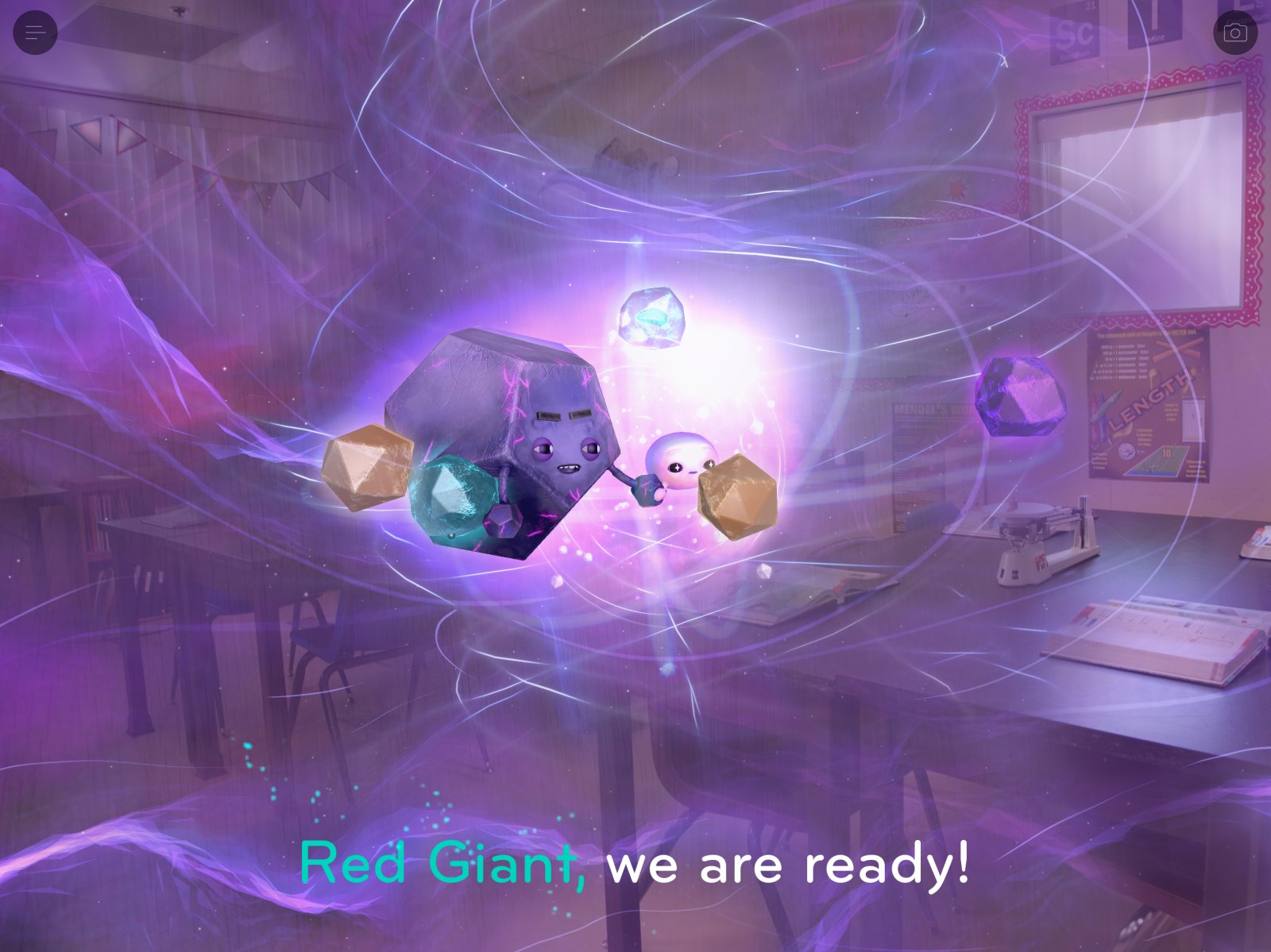
But those are conveniences, and not really essential services. Others like studio Within are trying to make AR more universally useful, by exploring ways of using it in education. It launched the Wonderscope app on iOS last November, as a way to get kids aged 6 to 8 to enjoy reading out loud. The company is about to add its fourth story called Clio’s Cosmic Quest to its library, and the experience revolves around helping an animated particle of stardust stand up to (then learn to understand and befriend) a bully.
The three other stories in Wonderscope are based on known tales like Goldilocks and the Three Bears, Alice in Wonderland and Little Red Riding Hood. But Within’s modern retellings of these stories tackle issues and topics that speak to today’s kids. The Red Riding Hood story, for example, has a STEM twist, in which the user helps Red build a gardening drone.
Meanwhile, Clio’s Cosmic Quest is an original story, but it uses new tech that, Within’s director of development Jonny Ahdout says, allows developers to create fully immersive content. This involves using Apple’s ARKit to craft characters, place them in a space that envelopes an entire room, not just a tabletop. It also offers safeguards for borders so your kid doesn’t go running into a wall, which, perhaps counterintuitively, makes it safe for them to go exploring within a room.
That’s important, too, as you might not be there with your child after handing your iPad off to them. Each story runs about 10 minutes, depending on how responsive the user is, so caretakers might not stick around for the whole experience. “Normally parents feel quite guilty about putting a device in front of their kids,” Ahdout said. But he thinks of Wonderscope as a “screen positive experience.” You can “hand Wonderscope to your kids and you’ll see them moving around playing talking, not just sitting and tapping in a corner of the room,” he added.
In each episode, the user meets the digital character, which appears in a virtual environment in front of you(r device’s camera). As the story progresses, words appear on the bottom of the screen that you’ll have to read out loud to advance. When you speak, the text on the screen is highlighted in green, and fades away when you’re done. The characters will then react to what you say, even making eye contact with you. It’s this combination of voice recognition and AR that makes for a more engaging experience, unlike a typical passive form of media consumption like watching yet another episode of Paw Patrol, for example.
Wonderscope’s makers also began to notice the app had a unique effect on an audience that they didn’t expect. Ahdout brought up one of the app’s many reviews on the iOS store where a parent mentioned how Wonderscope helped them get their autistic son to read.
Ahdout recalled a similar thing happening when Within first started testing the app. They had invited children to try it out, and a girl’s mother “freaked out when she learned it was a reading app.” She was “quite nervous it wasn’t going to work for her (daughter),” Ahdout said. But the girl started playing the Little Red episode, and as she read the words and the story progressed, Ahdout said the girl began to have fun and the pair walked out of the trial “so much happier.” These were some of the earliest signals to Within that they had found a way to make kids feel great about reading.
“That was a nice surprise that happened after we launched, and we want to continue digging into that,” Ahdout said.
I tried out an early version of Clio before its launch today and was impressed at the quality of production, animation and storytelling. The sound and visual effects were crisp and engaging, thanks in part to the iPad Pro that Within was using for the demo. I did find the voice recognition system a little lenient, as it would highlight words even if I misspoke and move me on to the next part of the story. To be fair, though, it’s for kids aged 6 to 8. Also, as Within co-founder and CEO Chris Milk told Engadget, the team didn’t set out to focus on accuracy. “It’s a totally different system than a Google (Assistant) or Siri, which is listening to someone speak and figuring out what you’re saying out of entire corpus of human language,” he said.
In Wonderscope, Milk said “We know what we want you to say and there’s a word we’re listening for.” More importantly, this lenience means “we can allow for children’s voices with a lisp or speech impediment.”
The app is available for free on ARKit-compatible devices running iOS 11 or newer. You’ll get an introductory story for free, but each other tale costs $4.99. Clio’s Cosmic Quest (also $4.99) is available now. And if you have a child at home that’s struggling to read, this might be a good way to instill confidence while teaching them valuable lessons about science, space and standing up to bullies.
South Korea appears to be the hardest hit country, suffering at least 10 attacks. India was the victim of three attacks, with Bangladesh and Chile the victim of two each. Meanwhile, Costa Rica, Gambia, Guatemala, Kuwait, Liberia, Malaysia, Malta, Nigeria, Poland, Slovenia, South Africa, Tunisia and Vietnam suffered one attack each.
The attacks were undertaken in three main ways: through the SWIFT system used to transfer money between banks; directly through exchanges and users to steal cryptocurrency; and by “cryptojacking” computers by infecting them with malware to use its resources to generate cryptocurrency.
In one unnamed country, for example, hackers managed to access the infrastructure managing its entire ATM system and installed malware modifying the way transactions are processed. In another country, stolen funds were “transferred through at least 5,000 separate transactions and further routed to multiple countries before eventual conversion” to a currency that a government has declared legal money, therefore making it extremely difficult to track the funds.
Meanwhile, South Korea’s cryptocurrency exchange, Bithumb, has been targeted at least four times. Two attacks in 2017 resulted in losses of around $7 million each, while a further two, in June 2018 and March 2019, lead to the loss of $31 million and $20 million respectively.
According to the report, many of these attacks are undertaken by actors operating under the direction of the Reconnaissance General Bureau — the General Bureau is North Korea’s military intelligence agency. The UN says that the attacks, which are “low risk and high yield” and often require little more than a laptop and internet access, are being investigated as attempts to violate UN sanctions.
Just in time to take advantage of significant Android Auto updates and upcoming CarPlay enhancements in iOS 13, Sony has announced an updated version of its in-car receiver, with a floating touchscreen display. The new 8.95-inch WVGA display is both bigger and requires only a single DIN space to install, making it easier to fit to a wider variety of cars. This new assembly allows the display to tilt, as well as adjust its height and depth. In this way, Sony makes it possible to add a big, spacious display to a car that normally wouldn’t have one. Compared to the car touchscreen competition, at $600 it’s also pretty cheap.
Verizon (Engadget’s parent company) is selling the social network to Automattic, the company behind the blogging tool WordPress. It’s not disclosing the size of the deal, but Automattic is taking on 200 employees as part of the exchange. Automattic chief Matt Mullenweg told the Wall Street Journal that this is his company’s largest acquisition both in terms of cost and sheer staff count. And in case you’re wondering: no, Automattic won’t reverse the ban on adult content. He saw Tumblr as a companion to WordPress and “just fun.”
It’s a low-key end to a long, rough chapter in Tumblr’s history. Yahoo bought the site in 2013 for a hefty $1.1 billion, but rumors suggest the selling prices is just a fraction of that.
Microsoft is joining the charge to sell its Office products as a subscription service. While users have traditionally purchased the Office suite as a one-off perpetual license, the company is pushing customers toward an annual subscription instead.
Microsoft will no longer sell one-off licenses for Office 2019 as part of its Home Use Program (HUP). The company updated its FAQ page to confirm: “Office Professional Plus 2019 and Office Home and Business 2019 are no longer available as Home Use Program offers.”
The HUP is a program aimed at employees in eligible companies, allowing them to buy the same Microsoft products they use at work to use at home. Previously, employees had been offered discounted rates for perpetual licenses. Now, they will have to purchase a subscription with a 30-percent discount, costing $48.99 a year for Office 365 Personal or $69.99 a year for Office 365 Home.
Two years in the making, and it’s canceled. The Minecraft team has decided to can its super-duper graphics pack after being unable to maintain a decent level of performance in-game. The pack was going to enable 4K on the Xbox One X and introduce much more sophisticated visual effects, which included atmospheric effects, highlights and more realistic water.
There is hope for a graphics tune-up in the future. Mojang said it was “looking into other ways” to give Minecraft a new look.
But wait, there’s more…
The Morning After is a new daily newsletter from Engadget designed to help you fight off FOMO. Who knows what you’ll miss if you don’t Subscribe.
Google added jobs to its search queries in 2017, rolling out from the US to the UK in 2018. It has certain features which make it appealing to users — not only is it very convenient, but it also lists salaries in its postings.
The problem is that smaller job listing companies say that Google’s practices are anticompetitive. The letter sent to the competition commissioner alleges that Google’s dominance in search gives it an unfair and possibly even illegal advantage over other job search companies, who have to spend large amounts of money on marketing. Google doesn’t have to spend a dime to market its job search, as it can leverage its position as the leader in search to funnel jobseekers to its listings.
The European Commission has stepped in to chastise Google for anticompetitive behaviors in the past. The company was fined nearly €1.5 billion ($1.7 billion) for “abusive” advertising practices, and has been forced to offer alternative browsers to Google Chrome on Android devices. In the case most similar to the current issue, Google was fined €2.4 billion ($2.7 billion) for promoting its own shopping service in search results, giving it an unfair advantage over rivals.
All of these cases were overseen by Margrethe Vestager, the competition commissioner. Vestager will be leaving her position on October 31st, but as reported by Reuters, there will be an extensive handover process so her successor will continue to investigate the issue.
If the commission does not respond to the letter sent by the other job search companies, the next step would be for the rivals to file a formal complaint against Google.
In an exclusive interview with Gamespot, Spencer said that consistency would be at the top of the agenda for the new console, ensuring that games load fast and run at the highest frame rate possible (in this case, 60 frames-per-second). Crucially, backwards compatibility will play a major role in the console’s design.
“Making sure that all four generations of content — so the original Xbox games that run on your Xbox One today, the OG Xbox; the 360 games that run on your Xbox One; your Xbox One games; and the new generation games — all run on the next platform is important to us,” said Spencer, adding that players with different generations of consoles will still be able to play each other.
Furthermore — and in a move that Spencer says “is a little bit new” for Microsoft — the console will “respect the compatibility of the controllers you already have.” Spencer points to players’ investment in personalized controllers, and says that the company wants to make sure those are compatible with future generations of the console as well.
This is all good news for Xbox fans. Upgrading to a new console can be a headache — restrictions on backwards compatibility and cross-gen gaming means players lose out on their previous gaming investments, or even put off buying a newer console because of all the mucking around involved. Microsoft seems to be showing genuine respect for its audience with these features, which is vital if the console is poised to dominate the market as critics believe it will when it launches next year.
The team has goals other than creating a squishy toy in mind, though. Ultimately, the chemists want to be able to create tiles of smart soft materials that can show medical information when placed on a person’s skin. The material could be used in wearable sensors that change colors, for instance, when it detects abnormally high or low blood sugar in diabetic patients. A whole Rubik’s Cube-like collection of the material could also be used to store a huge amount of information, considering the toy can form as many as 43 quintillion configurations.
Jonathan Sessler, a professor of chemistry at The University of Texas at Austin and co-author of the study, explained:
“Think of QR codes, which are patterns of black and white pixels on a two-dimensional surface used to store information. We’re exploring ways to encode information in patterns of color and in three dimensions, theoretically leading to a much higher information density.”